
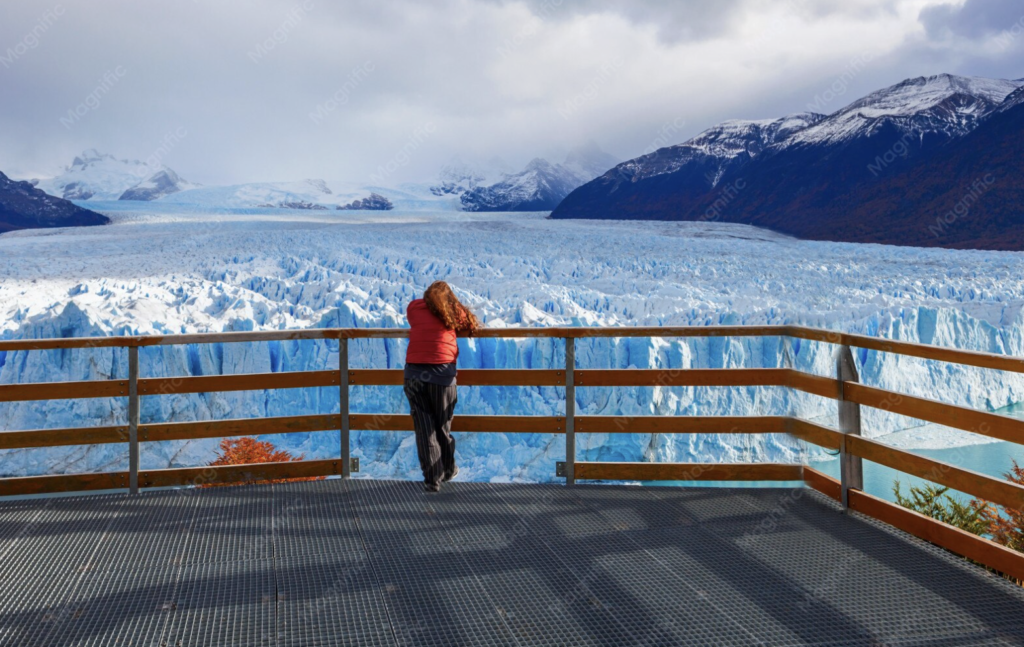
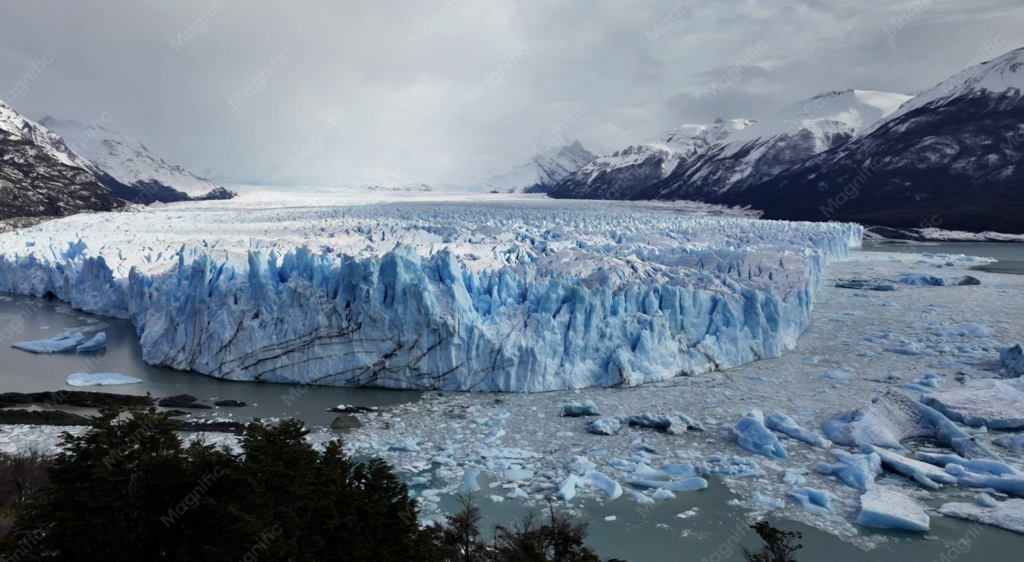
Perito Moreno is the rare glacier that puts on a show: massive chunks of ice calve off its 5km-wide face into Lago Argentino with a crack that echoes across the water, sometimes visible from the walkways without a boat or a guide. El Calafate, the small Patagonian town that serves as the gateway to it, has built an entire tourism economy around getting visitors close to one of the few advancing glaciers left on the planet. Here’s what you actually need to know to plan the trip in 2026.
Why Perito Moreno is different from other glaciers
Most glaciers worldwide are retreating due to climate change, which makes Perito Moreno genuinely unusual: it’s one of the few glaciers on Earth that remains in relative equilibrium, occasionally even advancing enough to dam Lago Argentino, causing dramatic ice-rupture events when the pressure finally breaks through. That stability, combined with a face that’s easy to view up close from a well-built network of walkways just a short boat ride or drive away, is why it’s become one of Patagonia’s signature attractions.
✈ COMPARE FARES IN SECONDS
Find Flights to El Calafate (FTE)
Search hundreds of airlines at once. Skyscanner compares every route from Buenos Aires and beyond so you lock in the best fare to Patagonia before it disappears.
100M+ travelers trust Skyscanner · Free to use, no hidden fees
How to get to El Calafate and the glacier
El Calafate has its own airport (FTE) with regular flights from Buenos Aires (about 3.5 hours) and seasonal connections from El Chaltén and other Patagonian hubs, making it far more accessible than most of remote Patagonia. From El Calafate town, the glacier itself is 80km away via the fully paved Provincial Route 11, roughly a 1.5-hour drive. Most visitors go with a tour that includes transfer, since renting a car mainly matters if you want full flexibility on timing or plan to combine the trip with other stops in the area.
If you’re also planning Torres del Paine across the border in Chile, our Torres del Paine W Trek Guide 2026 covers logistics for combining both in one Patagonia trip.
Ways to experience the glacier
The walkways (most visitors)
A network of metal walkways and viewing platforms built directly across from the glacier’s face lets most visitors get remarkably close without any hiking or special gear. This is the default option included in most day tours from El Calafate and is suitable for essentially any fitness level or age.
Minitrekking
A boat crosses Lago Argentino to the glacier’s edge, where crampons go on for a roughly 1.5-hour walk directly on the ice. The full excursion, including transfer, boat and trekking, runs about 9 hours from El Calafate. It’s rated moderate difficulty and suitable for ages 8 to 65.
Big Ice
The extreme version: about 3.5 hours actually walking on deeper, more dramatic sections of the glacier, exploring ice caves and crevasse formations the standard minitrekking doesn’t reach. It demands a higher fitness level and is generally limited to ages 18-50.
| Experience | Time on ice | Approx. cost (USD) | Fitness level |
|---|---|---|---|
| Walkways only | N/A (viewing) | ~$34 (park entrance) | Any level |
| Minitrekking | ~1.5 hours | ~$215+ (plus entrance) | Moderate, ages 8-65 |
| Big Ice | ~3.5 hours | ~$369+ (plus entrance) | High, ages 18-50 |
Prices are approximate USD conversions from Argentine pesos, which fluctuate significantly — always confirm current pricing directly with tour operators before booking, and budget some buffer given the peso’s volatility.
National park entrance fee
The glacier sits inside Los Glaciares National Park, a UNESCO World Heritage Site, and the entrance fee (around $50,000 ARS, roughly $34 USD at current rates) is paid separately from any tour price. Most operators don’t include it in their advertised rate, so factor it into your budget on top of whichever experience you choose.
⚕ GLACIER TREKKING NEEDS COVERAGE
Get Travel Insurance Before You Go
Minitrekking and Big Ice both involve real ice, crampons and real risk. SafetyWing covers medical emergencies, evacuation and trip delays from $45/month, with worldwide coverage that works for remote Patagonia excursions.
Used by 400K+ travelers worldwide · Cancel anytime
Best time to visit
El Calafate’s high season runs December through March (Southern Hemisphere summer), with the longest daylight hours and the best weather for viewing and trekking, but also the highest prices and the earliest sellouts for Minitrekking and Big Ice — spots can vanish weeks in advance during peak months. Shoulder seasons (October-November and April) offer a good balance of decent weather and thinner crowds. Winter (June-August) is far colder and some tours reduce frequency, though the glacier itself is visible year-round from the walkways.
What to pack
Patagonian weather is famously unpredictable, and El Calafate is no exception — wind is the defining factor more than cold, with gusts strong enough to make a lightweight jacket useless. Layering is essential: a wicking base layer, insulating mid-layer, and a genuinely windproof (not just water-resistant) outer shell. Gloves matter more than people expect, both for the ice excursions and for standing on exposed viewing platforms in Patagonian wind.
Recommended on Amazon
TRENDOUX Winter Gloves (3M Thinsulate)
Windproof, waterproof and warm to -20°F, built for standing on exposed glacier viewing platforms and handling gear during Minitrekking or Big Ice excursions.
Where to stay in El Calafate
El Calafate town itself has a full range of accommodation, from budget hostels to high-end lodges with lake views, and staying in town rather than near the park is the standard approach since the glacier is a day-trip distance away. Most visitors base themselves here for 2-3 nights, using it as a hub for the glacier plus any side trips toward El Chaltén.
How the glacier actually formed
Perito Moreno is one of 48 glaciers fed by the Southern Patagonian Ice Field, the third-largest reserve of fresh water on Earth after Antarctica and Greenland. It spans roughly 250 square kilometers and stretches about 30km in length, with a face reaching around 5km wide and up to 74 meters tall above the waterline where it meets Lago Argentino. The ice field that feeds it sits across the border in both Argentina and Chile, which is part of why Patagonia’s glacier network is often discussed as a single connected system rather than isolated attractions.
The rupture phenomenon
Because Perito Moreno periodically advances far enough to touch the opposite shore of Lago Argentino, it occasionally dams one arm of the lake completely, causing water levels to rise on one side until the pressure eventually breaks through in a dramatic ice-rupture event, sometimes drawing large crowds who travel specifically to witness it. These events aren’t predictable on a fixed schedule and can go years without occurring, so seeing one is more luck than planning, but even without a rupture, smaller ice calving happens regularly and is often visible from the walkways.
Sample 3-day El Calafate itinerary
Day 1: Arrive in El Calafate, settle into your accommodation, and spend the afternoon at Laguna Nimez Nature Reserve, a short walk from town with flamingos and good lake views for an easy first day.
Day 2: Full day at Perito Moreno Glacier — walkways in the morning, then Minitrekking or Big Ice if you’ve booked one, returning to town by early evening.
And on the Day 3: Either a rest day exploring El Calafate itself, or a day trip toward El Chaltén (about 3 hours each way) for a taste of Fitz Roy without committing to a multi-day trek.
Other things to do around El Calafate
Upsala Glacier and Spegazzini Glacier boat tours
Beyond Perito Moreno, Lago Argentino has several other glaciers reachable only by boat, including Upsala (one of South America’s largest glaciers by area, though retreating faster than Perito Moreno) and Spegazzini (with one of the tallest ice faces in the region). Full-day boat tours combining several of these are a popular alternative or addition to the standard Perito Moreno visit, especially for travelers with an extra day to spare.
🏔 SKIP THE PLANNING HEADACHE
Book Glacier Tours & Local Guides in El Calafate
Not sure whether to pick Minitrekking or Big Ice? Compare guided glacier excursions, boat tours and transfers with vetted local operators, with free cancellation up to 24h before most tours.
Rated 4.7/5 by over 2M travelers
Laguna Nimez Nature Reserve
A small, easy-access nature reserve right at the edge of town, good for spotting flamingos and other Patagonian birdlife without needing a full day trip. It’s a relaxed way to spend a few hours on an arrival or departure day.
El Chaltén day trips
Argentina’s self-declared trekking capital is about 3 hours from El Calafate by road, and while a proper Fitz Roy hike deserves its own multi-day visit, a long day trip to see the town and get a distant view of the peaks is possible for travelers short on time. For anyone with an extra day or two, staying overnight in El Chaltén and doing at least one of the shorter trails is worth the extra planning.
Food and drink in El Calafate
Patagonian lamb, typically slow-roasted over an open fire (asado de cordero), is the dish to seek out, along with excellent Argentine beef and a strong regional presence of Malbec and other Argentine wines pairing well with either. El Calafate’s small size means the restaurant scene is more limited than Buenos Aires or Mendoza, but the quality-to-price ratio for a good steak or lamb dinner remains high by international standards. Local chocolate shops selling Patagonian-style artisanal chocolate are also worth a stop, a small regional specialty that’s become something of a local tradition.
Budgeting for a full trip
Beyond the glacier excursion itself, budget for accommodation ($30-150/night depending on comfort level), meals ($10-25 per meal at a sit-down restaurant), and local transport or car rental if you’re not doing an all-inclusive tour. A 3-day trip covering the glacier with a mid-range Minitrekking excursion typically runs $500-800 per person all-in, excluding international flights to Argentina, though costs can shift meaningfully given how volatile the peso has been.
A note on currency and payments
Argentina’s currency situation has been genuinely volatile for years, with the peso losing significant value against the dollar over relatively short periods. Many tour operators and hotels in tourist areas price in or accept USD directly, which can actually work in your favor given the exchange rate dynamics, but always confirm which currency you’re being quoted in before booking, and carry some USD cash as backup since card payment reliability varies more than in most developed-market destinations.
Common mistakes to avoid
Not booking Minitrekking or Big Ice far enough ahead is the single most common regret, especially for anyone visiting in the December-March peak — these tours have limited daily capacity and simply sell out. Underestimating Patagonian wind is another classic mistake: a jacket that’s fine in most destinations often isn’t windproof enough here, and gloves that seem unnecessary become essential on an exposed viewing platform. Finally, forgetting to budget the national park entrance fee separately from the tour price catches some visitors off guard when they’re settling up.
🏠 WHERE TO STAY
Hotels & Lodges — Best Prices Guaranteed
From budget hostels to lake-view lodges. Compare 28 million listings on Booking.com in El Calafate. Free cancellation on most rooms, with no booking fees ever.
No booking fees · Pay at the property · Trusted by millions worldwide
Is Perito Moreno worth a special trip?
For most travelers already planning a Patagonia itinerary that includes Torres del Paine, El Chaltén, or Ushuaia, Perito Moreno is an easy yes — the accessibility relative to how spectacular the glacier is makes it one of the best effort-to-reward ratios in the entire region. For travelers considering Argentina specifically to see this one glacier, it still holds up, especially paired with even a short stop in Buenos Aires or El Chaltén to round out the trip, since El Calafate alone, while worthwhile, doesn’t offer enough on its own to fill more than 2-3 days comfortably.
Quick reference summary
| Category | Details |
|---|---|
| How to get there | Fly into El Calafate (FTE), then 80km/1.5hrs by road to the glacier |
| Park entrance | ~$34 USD, paid separately from tours |
| Best time to go | December-March (peak), Oct-Nov/April (shoulder) |
| Days needed | 2-3 days minimum |
| Booking window | Weeks ahead for Minitrekking/Big Ice in high season |
With the entrance fee, tour choice and season locked in, the only real decision left is whether you want ice under your boots or just a spectacular view — either way, the calving alone is worth the trip.
Combining El Calafate with the rest of Argentine Patagonia
Most itineraries treat El Calafate as one stop in a broader Patagonia loop, typically pairing it with El Chaltén for trekking, Ushuaia for the true end-of-the-world experience, and sometimes Bariloche further north for lake district scenery. Flights connect most of these Patagonian hubs directly, avoiding the long overland drives that used to define the region’s logistics, which makes stringing together a 10-14 day Patagonia itinerary far more realistic than it was even a decade ago.
If Ushuaia and the far south are part of your plan, note that flights from El Calafate down to Ushuaia are typically short and frequent, making a 3-4 day extension south relatively easy to bolt onto an existing glacier-focused trip without adding excessive travel time or logistical complexity.
Whichever combination of stops you pick, book El Calafate’s glacier excursions first — they’re the piece of the itinerary with the least flexibility once high season demand kicks in, and everything else in Patagonia is easier to slot around a fixed glacier date than the other way around.
Lock that in early, build the rest of the trip around it, and El Calafate ends up being one of the simplest, highest-payoff stops in a Patagonia itinerary rather than the logistical headache it might look like on paper.
Between the ice, the wind, and the sheer scale of the Southern Patagonian Ice Field feeding it, Perito Moreno remains one of the few natural landmarks that genuinely looks better in person than in any photo — and in 2026, getting there has never been more straightforward.
Now Plan …
Plan around the booking windows, respect the wind, and the rest of the trip tends to fall into place on its own.
Few destinations in South America reward that little bit of extra planning as reliably as this one does.
Bring the gloves, book the excursion early, and let one of the world’s few advancing glaciers do the rest of the work.
That combination of accessibility, scale, and genuine natural drama is exactly why El Calafate keeps earning its spot on every serious Patagonia itinerary, year after year.
Start with the excursion booking, and everything else about the trip becomes much easier to plan around it.
It’s one of the few places in the world where the postcard version genuinely undersells the reality.
⚖ FLIGHT DELAYED? CANCELED?
Claim Up To €600 in Compensation
Was your flight to Argentina delayed, canceled or overbooked in the last 3 years? You may be owed compensation. AirHelp handles all the paperwork — you get paid.
No win, no fee · 2M+ passengers helped · Free 2-minute check
Frequently Asked Questions About Visiting Perito Moreno
Do I need to book Minitrekking or Big Ice in advance?
Yes, especially December-March, when spots sell out weeks ahead. Book at least a few weeks before your trip in high season.
How much does it cost to visit Perito Moreno Glacier?
Park entrance alone runs about $34 USD. Minitrekking starts around $215+ and Big Ice around $369+, both plus the park entrance fee.
Is Perito Moreno really growing while other glaciers shrink?
It stays in relative equilibrium and occasionally advances, which is unusual — most glaciers worldwide are retreating due to climate change.
How do I get from El Calafate to the glacier?
It’s 80km via Provincial Route 11, about a 1.5-hour drive, most commonly done as part of a tour with transfer included.
What’s the difference between Minitrekking and Big Ice?
Minitrekking is about 1.5 hours on the ice, suitable for ages 8-65. Big Ice is 3.5 hours in more demanding terrain, generally for ages 18-50.
Can I see the glacier without doing an ice trek?
Yes, the walkway network lets you view the glacier’s face up close without any hiking, suitable for any fitness level.
When is the best time to visit?
December-March for best weather and longest days, but expect peak prices and early sellouts. October-November and April offer a good balance.
Recommended on Amazon
LEADHALO 100% Merino Wool Base Layer
Genuine merino wool base layer built for the temperature swings around Perito Moreno — cold on the ice, warmer once you’re back on the walkways or in town.
Is El Calafate connected by flight or only by bus?
El Calafate has its own airport (FTE) with regular flights from Buenos Aires, about 3.5 hours.
Can I combine El Calafate with Torres del Paine?
Yes, it’s a common Patagonia route, crossing the border into Chile; expect a full day of travel between the two areas.
Is the entrance fee included in tour prices?
Usually not. Los Glaciares National Park entrance is typically paid separately from Minitrekking, Big Ice or walkway tour prices.
Conclusion: worth the trip to the end of the world
Perito Moreno delivers on the hype in a way few natural attractions do, and the fact that it’s actually accessible via a short flight and a well-paved road, rather than a multi-day expedition, makes it one of the most efficient ways to see a genuinely spectacular glacier up close. Pick the walkways if you want a straightforward, low-effort day; go for Minitrekking or Big Ice if you want to actually stand on the ice. Either way, book ahead in high season, pack for real Patagonian wind, and budget the park entrance fee separately from your tour cost.
Continuing your Patagonia trip? See our El Chaltén & Fitz Roy Photography Guide and Argentina Visa Requirements 2026.