
Few photos have done more for Peruvian tourism than the striped ridge of Rainbow Mountain. A decade ago almost nobody outside the Cusco region had heard of Vinicunca; today thousands of travelers make the pre-dawn drive every day in high season, and a second “rainbow mountain” — Palccoyo — has become the go-to alternative for people who want the colors without the crowds or the brutal altitude.
So which one should you choose? In this guide I compare Vinicunca vs Palccoyo side by side: altitude, hike length and difficulty, crowds, what you actually see at the top, entrance fees, tour prices, the best time of year to go, how to acclimatize, what to pack and how to avoid the classic mistakes that ruin the day. By the end you will know exactly which Rainbow Mountain fits your fitness level, your schedule and your budget.
If you are planning your wider trip, pair this guide with our Cusco travel guide and the 5-day Cusco, Sacred Valley and Machu Picchu itinerary. Photographers should also read our dedicated Rainbow Mountain photography guide.
What Is Rainbow Mountain and Why Is It Colored?
Rainbow Mountain is not a single peak but a type of landscape found in the Andes south-east of Cusco, close to the glaciated Ausangate massif. The stripes are layers of sediment — sandstones, mudstones and limestones — laid down over millions of years and then tilted and exposed by tectonic uplift and erosion. Different minerals oxidize into different colors: iron oxides give the reds and pinks, iron sulfide and goethite create the yellows and mustards, chlorite produces the greens, and calcium carbonate adds the whites and lilacs.
For centuries Vinicunca was covered by snow for much of the year. As the glaciers retreated in recent decades, the colors became visible for longer, and social media did the rest. For the local Quechua communities who manage access, tourism has transformed the local economy in a few short years.
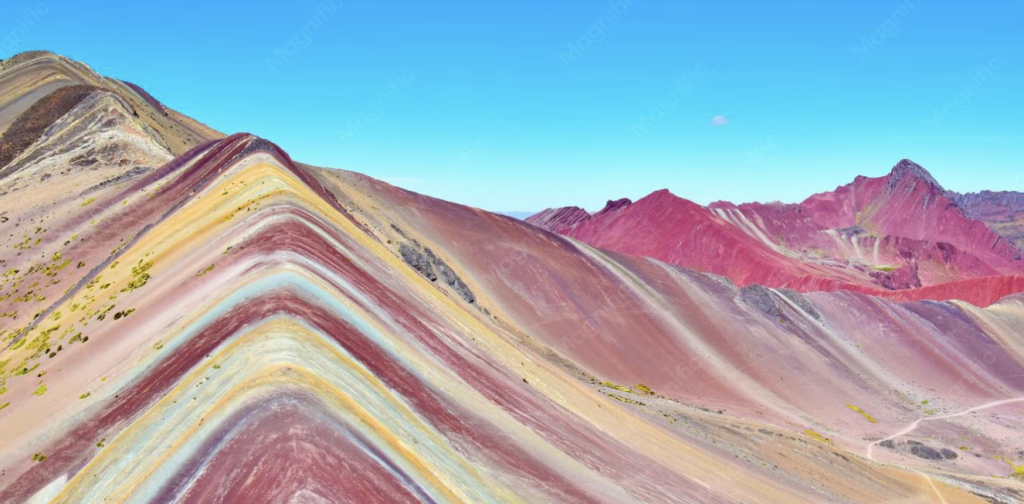
Vinicunca vs Palccoyo at a Glance
| Feature | Vinicunca (classic Rainbow Mountain) | Palccoyo (alternative Rainbow Mountain) |
|---|---|---|
| Summit altitude | ~5,036–5,200 m (16,500–17,060 ft) at the viewpoint | ~4,900 m (16,076 ft) |
| Hike length | About 4 km one way (8–10 km round trip) | About 3 km circuit |
| Hiking time | 1–1.5 h up, 1 h down (longer if you are slow at altitude) | 45 min–1 h up, easy return |
| Difficulty | Challenging, mainly because of altitude | Moderate, gentle gradients |
| What you see | One dramatic striped ridge, Ausangate glacier, optional Red Valley | Three colored ridges, a stone forest, many llamas and alpacas |
| Crowds | Very high, especially June–August | Low to moderate |
| Drive from Cusco | About 3 hours | About 3 hours |
| Entrance fee | About S/30 (≈ US$8) | Small community fee (usually included in tours) |
| Typical group tour price | US$25–65 | US$35–70 |
| Best for | Bucket-list photo, fit and acclimatized hikers | Families, older travelers, short stays in Cusco |
Vinicunca: The Classic Rainbow Mountain
The route
Tours leave Cusco between 3:00 and 3:30 a.m. and drive about three hours through the towns of Cusipata and Checacupe, stopping for breakfast on the way. The final stretch climbs on a dirt road to the trailhead parking area at roughly 4,600 m. From there a wide, well-trodden path climbs steadily through a valley with herds of alpacas, glacier-fed streams and views of Ausangate (6,384 m), the sacred mountain of the region.
The last 30–40 minutes are the hardest: a steep zig-zag to the viewpoint saddle. At the top you get the iconic view of the striped ridge on one side and the Red Valley (Valle Rojo) on the other. Many people also climb the small hill opposite the rainbow ridge for the classic panoramic shot — it adds another 50–100 vertical meters at an altitude where every step counts.
Horses and alternatives
Local families rent horses for the uphill part of the trail for around S/90 (about US$25). Horses cannot take you up the final steep section, so you will still have to walk the last stretch. Accept the horse if you feel dizzy, nauseous or extremely slow — there is no prize for suffering, and the horses support the local economy.
The Red Valley extension
Some tours add a loop through the Red Valley, a deep crimson landscape just beyond the viewpoint. It costs an extra fee of around S/30 paid on site and adds 1–2 hours of hiking. It is spectacular and far less crowded, but only worth it if you still feel strong at the summit.
🎟 TOURS & ACTIVITIES
Book guided tours with local experts
Day trips, treks and experiences led by licensed guides, with free cancellation up to 24 hours before.
✓ Licensed guides · ★ 10M+ happy travelers · ↺ Free cancellation
Palccoyo: The Easier Rainbow Mountain
Palccoyo sits in the neighboring Checacupe district, also about three hours from Cusco. The trailhead is higher up the mountain, so the walk is shorter and the gradients much gentler. In 45 minutes to an hour you reach a ridge with three separate rainbow mountains lined up in front of you, plus a short detour to a “stone forest” of eroded rock pinnacles.
The colors at Palccoyo are slightly less saturated than at Vinicunca, and you do not get the same close-up view of Ausangate. On the other hand you will often share the viewpoint with only a few dozen people, the llamas and alpacas are everywhere, and the whole experience feels calmer and more local. It is the option I recommend for travelers with only two or three days in Cusco, families with children, older travelers and anyone worried about altitude.
Which Rainbow Mountain Should You Choose?
- Choose Vinicunca if you are fit, have at least three nights of acclimatization in Cusco or the Sacred Valley, and you want the famous view and the Red Valley.
- Choose Palccoyo if you just arrived in Cusco, you are traveling with kids or older relatives, you hate crowds, or you want the colors with less risk of altitude sickness.
- Do both only if you have lots of time: they cannot be combined in one day, and each is a full-day trip.
A third option, Pallay Punchu, has appeared in recent years: a jagged ridge with striking colors further south, with very few visitors. It requires a longer drive and is best done with a private tour.
Altitude: The Real Challenge
Neither hike is technical. The difficulty is the thin air: at 5,000 m there is roughly half the oxygen available at sea level. Altitude sickness can hit anyone regardless of fitness, so your acclimatization plan matters more than your gym routine.
- Spend at least two nights in Cusco (3,400 m), ideally three, before Vinicunca. Sleeping lower in the Sacred Valley (2,800 m) for a couple of nights is even better.
- Drink plenty of water and avoid alcohol the night before.
- Coca tea and coca candies help many people; talk to your doctor about acetazolamide if you are prone to altitude sickness.
- Walk slowly and breathe deeply. Let the group go ahead if you need to.
- Turn back if you experience severe headache, confusion, vomiting or loss of coordination.
Our complete guide to altitude sickness in Cusco and Machu Picchu explains symptoms, prevention and treatment in detail.
🛡 TRAVEL INSURANCE
Trek the Andes fully covered
Medical cover built for long trips and nomads, from about $1.60 per day. Sign up even if you are already on the road.
✓ 180+ countries · ⚕ Hospital & emergency cover · ⏱ Cancel anytime
When to Visit Rainbow Mountain
| Season | Months | Weather | Colors and conditions |
|---|---|---|---|
| Dry season | May–September | Clear skies, freezing mornings (–5 °C at dawn) | Reliable views, biggest crowds June–August |
| Shoulder | April, October | Mostly dry, some clouds | Best balance of weather and crowds |
| Wet season | November–March | Afternoon rain, occasional snow | Colors can look more saturated when wet; snow can cover the stripes |
February is the rainiest month and some operators reduce departures. For the best mix of weather and fewer people, aim for April–May or September–October. Our month-by-month guide to Peru’s weather covers the rest of your itinerary.
Tour vs Independent Visit
Almost everyone visits on a tour, and for good reason: the trailheads are remote, public transport is unreliable, and the 3 a.m. start is much easier when someone picks you up at your hotel. Standard group tours typically include:
- Hotel pickup between 3:00 and 3:30 a.m. and return to Cusco around 5–6 p.m.
- Transport in a minibus or van
- A bilingual licensed guide
- Breakfast on the way and buffet lunch on the return
- Entrance fee (check this!)
- Emergency oxygen and first-aid kit
What is usually not included: water, walking poles, the Red Valley extension, horse rental and tips (S/20–30 per person is customary for the guide and driver).
| Tour type | Price per person (approx.) | What to expect |
|---|---|---|
| Budget street-booked tour | US$20–30 | Large groups, basic food, entrance fee sometimes extra |
| Mid-range group tour | US$35–48 | Smaller groups, better guides and meals |
| Premium small-group tour | US$49–65 | 10–12 people max, oxygen, quality vehicles |
| Private tour | US$120–250 | Flexible timing, can choose Palccoyo or Pallay Punchu |
| Independent (colectivos + taxi) | US$40–60 total | Complicated logistics, not recommended for first-timers |
🏨 WHERE TO STAY
Book your stay with free cancellation
Hostels, boutique hotels and Andean lodges with verified guest reviews and flexible bookings in case your plans change.
✓ No booking fees · ★ 28M+ listings · ↺ Free cancellation on most stays
What to Pack for Rainbow Mountain
- Layers: thermal base layer, fleece, insulated jacket and a windproof shell. It can be below freezing at dawn and warm in the sun by midday. See our picks for the best base layers for high-altitude trekking and insulation jackets for the Andes.
- Sturdy boots with good grip for loose gravel on the descent. Our high-altitude boot guide has options for every budget.
- Hat, gloves and buff for the morning cold; sunglasses, sunscreen (SPF 50) and lip balm for the intense UV.
- 1.5–2 liters of water and snacks (chocolate, nuts, coca candies).
- Walking poles — they make a huge difference on the descent.
- Cash in small soles for toilets, horses, the Red Valley fee and snacks.
- A charged phone and a power bank, because cold drains batteries fast.
🛒 GEAR PICK ON AMAZON
Collapsible trekking poles
Lightweight, foldable poles take pressure off your knees on the steep, gravelly descent from Vinicunca and fit easily in your daypack.
Common Mistakes to Avoid
- Going on your first or second day in Cusco. This is the number one reason people feel terrible at the top.
- Booking the cheapest tour on the street without checking group size, oxygen and whether the entrance fee is included.
- Dressing too lightly because Cusco felt warm in the afternoon.
- Running to the viewpoint for the photo — slow and steady wins at 5,000 m.
- Expecting the Instagram filter. Many famous photos are saturated; the real colors are softer but still beautiful.
Responsible Travel at Rainbow Mountain
The trails are managed by local Quechua communities, and the fees fund maintenance and community projects. Stay on the marked paths to prevent erosion, take your trash back to Cusco, ask before photographing people and their animals (a small tip is expected), and consider Palccoyo or Pallay Punchu to spread tourism benefits beyond Vinicunca.
✈ FIND CHEAP FLIGHTS
Fly to South America for less
Compare hundreds of airlines and booking sites at once and grab the lowest fare for your dates — including budget domestic hops between Andean cities.
✓ Free to use · 🌍 100M+ travelers monthly · 🔔 Price alerts
A Typical Vinicunca Tour, Hour by Hour
- 3:00–3:30 a.m. – Hotel pickup in Cusco. Bring your warm layers in the van; it is freezing outside.
- 5:30 a.m. – Breakfast stop in a village near Cusipata: bread, eggs, pancakes, coca tea and coffee.
- 7:00 a.m. – Arrival at the trailhead (around 4,600 m). Toilets, last chance to rent a horse, guide briefing.
- 7:15–8:45 a.m. – The hike up through the valley, with stops to catch your breath and photograph alpacas and the Ausangate glacier.
- 8:45–9:30 a.m. – Time at the viewpoint for photos. Optional climb to the opposite hill for the panorama, or the Red Valley extension.
- 9:30–10:30 a.m. – Descent back to the parking area.
- 12:30 p.m. – Buffet lunch on the way back.
- 4:00–5:30 p.m. – Return to Cusco. Most people go straight to bed!
Palccoyo tours follow a similar schedule, but because the hike is shorter you may get back to Cusco an hour or so earlier.
Photography Tips for Both Rainbow Mountains
The light is best in the early morning, before clouds build up around midday. A polarizing filter deepens the colors and cuts glare, but be careful not to overdo it. Include people or alpacas for scale, and shoot the ridge from slightly higher ground to show the layers. If clouds roll in, wait a few minutes — the weather changes fast and the sun often breaks through. For drone users: flying rules change and some communities forbid drones, so always ask your guide first. Our full Rainbow Mountain photography guide covers camera settings, lenses and composition in depth.
Rainbow Mountain vs Other Andes Highlights
| Experience | Max altitude | Duration | Difficulty |
|---|---|---|---|
| Palccoyo Rainbow Mountain | ~4,900 m | Full day | Moderate |
| Vinicunca Rainbow Mountain | ~5,036–5,200 m | Full day | Challenging (altitude) |
| Humantay Lake | ~4,200 m | Full day | Moderate–challenging |
| Salkantay Trek | ~4,630 m | 4–5 days | Challenging |
| Classic Inca Trail | ~4,215 m | 4 days | Moderate–challenging |
| Ausangate Trek | ~5,200 m | 5–6 days | Very challenging |
If you want to see Rainbow Mountain as part of a multi-day adventure, the Ausangate trek circles the sacred mountain and can include Vinicunca on the final days, before the day-trippers arrive. It is a serious high-altitude trek with passes above 5,000 m and camping in freezing temperatures, so it is only for experienced, well-acclimatized hikers with a good operator.
Health and Safety Checklist
- Check with your doctor before the trip if you have heart or lung conditions — high altitude can make them worse.
- Make sure your travel insurance covers trekking up to at least 5,000 m and emergency evacuation.
- Eat a light dinner the night before and a proper breakfast on the way.
- Carry a small personal first-aid kit with painkillers, blister plasters and any personal medication.
- Know the warning signs of altitude sickness and tell your guide immediately if you feel unwell.
How to Fit Rainbow Mountain Into Your Peru Itinerary
The smartest place for Rainbow Mountain in a Peru itinerary is after a few easier days around Cusco and the Sacred Valley, and before any multi-day trek. A sample sequence that works well for most travelers:
- Day 1: Arrive in Cusco, rest and take a gentle walk around the historic center.
- Day 2: Sacred Valley tour (Pisac, Ollantaytambo), sleeping lower in the valley.
- Day 3: Machu Picchu.
- Day 4: Back in Cusco, free day for museums and San Blas.
- Day 5: Rainbow Mountain (Vinicunca or Palccoyo).
- Day 6: Rest day or Humantay Lake.
Following this order you arrive at Rainbow Mountain with four nights of altitude in your legs, which makes the hike far more enjoyable. If you are short on time and must go early in your trip, choose Palccoyo.
Is Rainbow Mountain Worth It?
Honest answer: for most travelers, yes — but with the right expectations. You will get up in the middle of the night, spend six hours in a van and hike at an altitude higher than any peak in the Alps. In return you see a landscape that looks almost unreal, surrounded by glaciers, alpacas and Quechua herders who still live much as their ancestors did. If you are short on energy or time, Palccoyo delivers most of the magic with a fraction of the effort, and you will still come home with photos that make your friends ask where on earth you were.
Frequently Asked Questions
Which is better, Vinicunca or Palccoyo?
Vinicunca has the iconic single striped ridge, the Ausangate glacier and the Red Valley, but it is higher, harder and crowded. Palccoyo is easier, quieter and shows three colored ridges. Choose Vinicunca if you are fit and acclimatized; choose Palccoyo if you want an easier hike.
How high is Rainbow Mountain in Peru?
The Vinicunca viewpoint sits at roughly 5,036–5,200 meters (about 16,500–17,000 feet) depending on where it is measured. Palccoyo reaches around 4,900 meters.
How hard is the Rainbow Mountain hike?
The Vinicunca hike is around 4 km each way and is challenging mainly because of the altitude. Palccoyo is a short 3 km circuit with gentle gradients and is considered moderate.
How much does a Rainbow Mountain tour cost?
Group tours from Cusco usually cost between US$25 and US$65 per person depending on quality, plus around S/30 for the Vinicunca entrance fee if it is not included. Private tours cost US$120–250.
Can I get a horse at Rainbow Mountain?
Yes. Local families rent horses for the uphill part of the Vinicunca trail for about S/90 (US$25), but you still need to walk the final steep section to the viewpoint.
How many days should I acclimatize before Rainbow Mountain?
Spend at least two nights, ideally three, in Cusco or the Sacred Valley before hiking Vinicunca. Palccoyo is more forgiving if you have less time.
What is the best time to visit Rainbow Mountain?
April–May and September–October offer the best balance of good weather and smaller crowds. June to August is the driest period but also the busiest.
Is the Red Valley worth it?
Yes, if you still feel strong at the summit. The extension costs around S/30, adds 1–2 hours and offers a deep red landscape with far fewer people.
Can kids hike Rainbow Mountain?
Older children who are acclimatized can usually manage Palccoyo comfortably. Vinicunca is more demanding because of the altitude, so check with your doctor and consider a horse.
Can I visit Rainbow Mountain without a tour?
It is possible with colectivos and a taxi from Checacupe or Cusipata, but logistics are complicated and costs end up similar to a tour. Most travelers find a reputable small-group tour easier and safer.
Conclusion: Pick the Rainbow Mountain That Fits Your Trip
Both rainbow mountains are unforgettable. Vinicunca rewards fit, well-acclimatized hikers with the legendary view, the Ausangate glacier and the Red Valley. Palccoyo offers three colorful ridges, llamas and peace for anyone who wants an easier day. Whichever you choose, give your body time to adjust to the altitude, book a reputable tour and start early.
Ready to plan the rest of your Andes adventure? Check our Salkantay trek guide, the Inca Trail guide and our honest look at how much it costs to travel the Peruvian Andes.