
Best Portable Solar Panels for Andes & Patagonia Trekking 2026: Off-Grid Power Guide

At 3,900 metres on the Bolivian altiplano, in the middle of the dry season, the sun rises at 6:15 AM and sets at 6:00 PM. There is no cloud cover. No humidity. No atmosphere to scatter the light. Just twelve hours of direct, high-intensity solar radiation hitting your pack and everything attached to it. On a 5-day crossing with a 21W portable solar panel clipped to the outside of your bag, you can generate enough power to fully recharge a 20,000 mAh power bank — every single day.

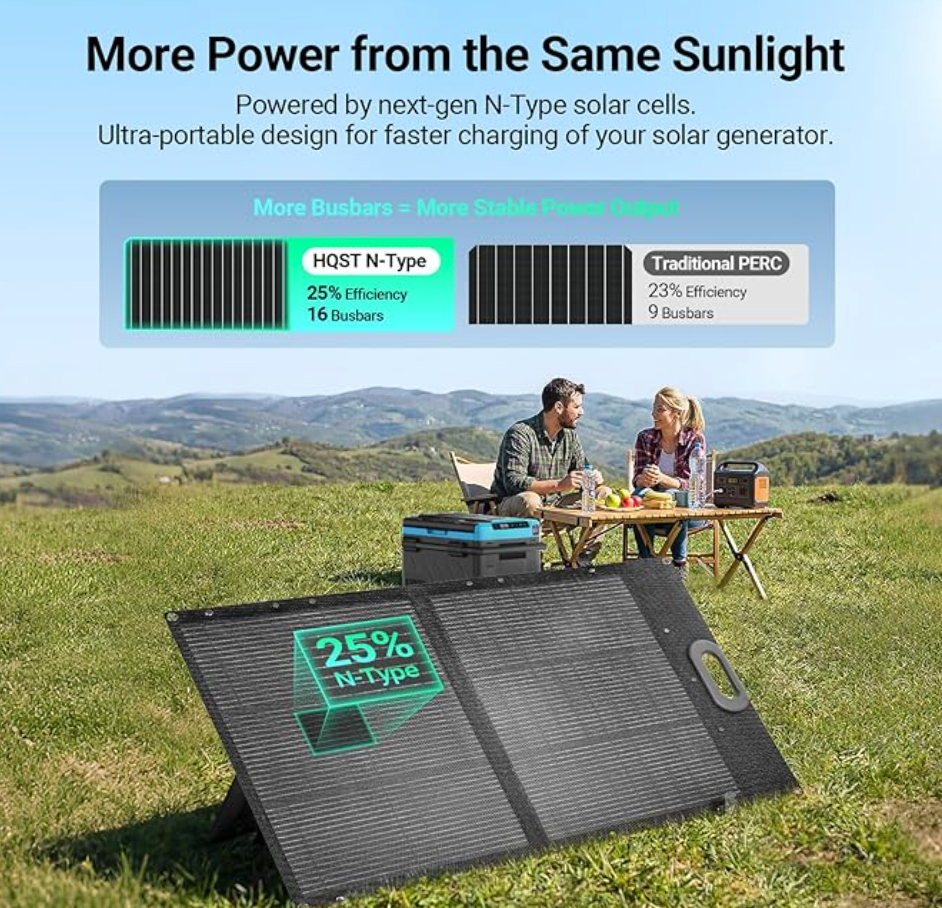
Portable solar panels for travel have improved dramatically in the past three years. The panels available in 2026 are lighter, more efficient, and more durable than their predecessors — the best options in this guide achieve 22–23% monocrystalline conversion efficiency, which is approaching the efficiency of fixed residential solar installations at a fraction of the weight and cost. For Andes and Patagonia trekkers who want genuinely unlimited power on extended off-grid routes, a portable solar panel paired with a high-capacity power bank is the most reliable solution available.

This guide covers the best portable solar panels for Andes and Patagonia trekking and travel in 2026. Every pick is evaluated for the specific light conditions of high-altitude South American environments. Amazon links with my affiliate code are included for each recommendation.

FIND YOUR FLIGHT

Fly to Cusco, La Paz, or Lima — the solar-rich Andes await. Compare flights and book your South America gateway.

The Bolivian altiplano and the Peruvian highlands offer some of the best portable solar conditions on Earth. Lima (LIM), Cusco (CUZ), and La Paz (LPB) are your gateways.

Prices update in real time. Booking through this link supports Uncover the Andes at no extra cost to you.

How Portable Solar Panels Work — and Why High Altitude Changes the Equation

A portable solar panel converts sunlight into direct current (DC) electricity through photovoltaic cells — the same technology used in residential solar installations, reduced to a portable format. The efficiency of conversion (how much of the sunlight hitting the panel becomes usable electricity) determines how much power you generate per unit of panel area. Consumer portable solar panels in 2026 range from 15% to 23% conversion efficiency — a significant range that directly affects the panel’s weight and size for a given power output.

Why high altitude improves solar performance: At 4,000 metres above sea level, the atmosphere above you is 40% thinner than at sea level. This means significantly less atmospheric scattering and absorption of solar radiation — the solar irradiance (watts per square metre of sunlight) reaching your panel is 15–20% higher than the same panel would receive at sea level. The practical result: a 21W-rated panel used at 4,000m altitude in clear conditions generates approximately 24–25W of actual output — exceeding its sea-level rated wattage.

UV intensity at altitude: The same UV increase that makes sunscreen essential for trekkers also benefits solar panels — the UV component of solar radiation is a meaningful portion of the energy that photovoltaic cells convert. This compounds the altitude advantage, making the Bolivian altiplano and high Peruvian plateau among the best solar charging environments on Earth.

The table

LocationAltitudeSolar Irradiance Factor21W Panel Daily Output20,000 mAh Charge Time
Sea level (reference)0m1.0x reference~80–100 Wh (4–5 hrs sun)2+ days
Cusco, Peru3,400m1.12x~100–120 Wh (5 hrs sun)1.5–2 days
Inca Trail (Salkantay Pass)4,300–4,600m1.18x~110–130 Wh (6 hrs sun)1–1.5 days
Bolivian Altiplano3,650–4,000m1.15x~115–140 Wh (8–10 hrs sun)1 day (dry season)
Torres del Paine, Patagonia800m1.02x~40–80 Wh (cloud dependent)3–5 days (unreliable)
Portable solar panel output by Andes and Patagonia location — 21W panel, dry season conditions.

The Patagonia caveat: Portable solar panels are substantially less useful in Patagonia than in the Bolivian altiplano or the Peruvian highlands. The Torres del Paine W Circuit has cloud cover and rain on 50%+ of days even in peak season — a solar panel generating 40W on a clear day generates near-zero output under overcast Patagonian sky. For Patagonia, a high-capacity power bank is the more reliable primary power solution. A solar panel can serve as an opportunistic supplement on clear days but should not be relied upon as primary power.

GEAR GUIDE

Best Power Banks for Andes Trekking and South America Travel 2026

The primary power storage guide — the power banks that work best paired with the solar panels in this article.

Read the Guide

The 6 Best Portable Solar Panels for Andes and South America Travel 2026
BEST OVERALL

BigBlue 28W Solar Charger

The best balance of wattage, weight, and price for Andes and altiplano trekking.

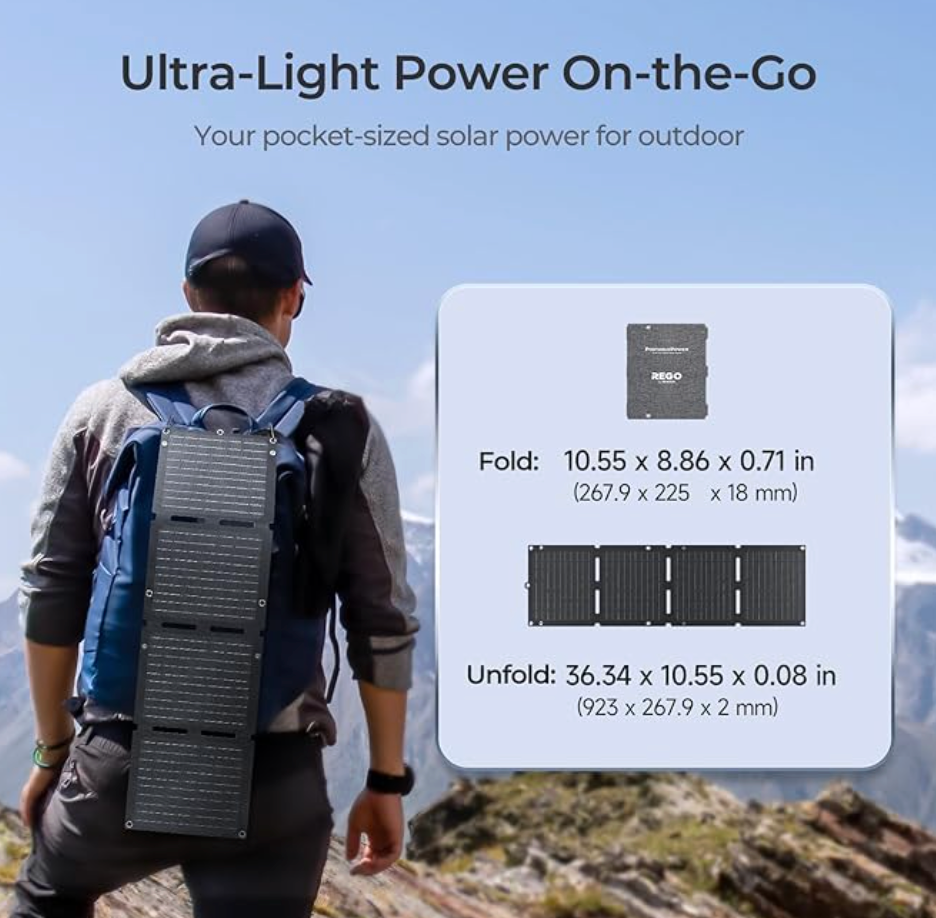
The BigBlue 28W is the most consistently recommended portable solar charger for Andes trekking across outdoor and photography communities, and it earns the position through a combination of genuine 28W output, smart USB charging (the integrated Smart IC chip detects each device’s optimal charging current), and a foldable four-panel design that maximises surface area while packing to a size comparable to a standard paperback book. At 520g, it is heavier than the ultralight single-panel options below but delivers substantially more power — particularly relevant at altitude where maximising output per hour of available sunlight matters. The three USB-A ports allow simultaneous charging of phone, camera batteries, and a power bank at the same time.

Wattage: 28W peakEfficiency: 21.5–24% monocrystallinePorts: 3x USB-A with Smart ICWeight: 520gFolded Size: 33 x 16 x 4 cm
  • +28W peak output — highest wattage in the foldable USB solar charger category
  • +3 simultaneous USB-A ports — phone + camera + power bank charging in parallel
  • +Smart IC chip — auto-detects and delivers optimal charging current per device
  • +21.5–24% efficiency — approaches theoretical maximum for consumer panels
  • +Best at altitude — 28W rated output becomes 32–34W actual at 4000m+ in clear conditions
Check Price on Amazon

As an Amazon Associate, Uncover the Andes earns from qualifying purchases at no extra cost to you.

Best Portable Solar Panels for Andes & Patagonia Trekking
BEST LIGHTWEIGHT

Anker 21W USB Solar Charger

Anker reliability and a featherlight 400g — the best compact solar panel for Inca Trail trekkers.

The Anker 21W is the solar panel most frequently recommended by the Inca Trail and Salkantay trekking community for its combination of reliable output, compact folded size, and Anker’s well-established quality track record. At 400g, it is the lightest option in this guide with a meaningful wattage output. The dual USB-A ports with Anker’s PowerIQ charging technology deliver consistent output even as cloud cover varies — PowerIQ adjusts output to device requirements in real time rather than dropping to a fixed low voltage when direct sunlight is interrupted. The PowerIQ feature matters significantly on the Inca Trail cloud forest section, where intermittent cloud passes are frequent.

Wattage: 21W peakPorts: 2x USB-A with PowerIQWeight: 400gFolded Size: 29 x 16 x 4 cmTechnology: PowerIQ adaptive charging
  • +400g — lightest meaningful-wattage solar panel in this guide
  • +PowerIQ adaptive charging — maintains output through cloud interruptions
  • +Anker quality control — most consistent brand in portable solar charging
  • +Best for Inca Trail and Salkantay where cloud forest reduces sustained direct sun
  • +Clips easily to pack exterior — no separate mounting hardware needed
Check Price on Amazon

As an Amazon Associate, Uncover the Andes earns from qualifying purchases at no extra cost to you.

BEST WITH BUILT-IN BATTERY

BioLite SolarPanel 10+ with Integrated Battery

Solar panel and power bank in one — the most elegant integrated system for trail use.

The BioLite SolarPanel 10+ solves the primary inconvenience of solar panels on a trek: the panel needs to face the sun, but the device being charged needs to be in your bag or pocket. By integrating a 3,000 mAh battery directly into the panel, the SolarPanel 10+ stores solar energy in its own battery throughout the day, then delivers that stored charge to your devices whenever you need it — without requiring a separate power bank connection during charging. The sundial kickstand adjusts panel angle for maximum sun exposure throughout the day, and the 10W USB-C output is the fastest in the smaller-panel category. Best for trekkers who want a simpler one-device system rather than a panel-plus-bank combination.

Wattage: 10W peakBuilt-in Battery: 3,000 mAhPorts: 1x USB-C (10W) + 1x USB-AWeight: 300gNotable: Integrated battery + sundial angle kickstand
  • +Integrated 3,000 mAh battery — stores solar during the day, charges devices on demand
  • +Sundial kickstand — optimises panel angle throughout the day automatically
  • +300g — lightest complete system (panel + battery) in this guide
  • +Simplest use case — one device replaces both panel and power bank for light users
  • +10W USB-C output — fastest charge port in the sub-15W panel category
Check Price on Amazon

As an Amazon Associate, Uncover the Andes earns from qualifying purchases at no extra cost to you.

Best Portable Solar Panels for Andes & Patagonia Trekking
BOOK YOUR TREK

Solar-optimised Andes routes — Bolivia, Peru, and the altiplano. Book your guided expedition before the dry season fills.

The Bolivian altiplano dry season (May–October) offers the best portable solar charging conditions in South America. Book early for peak-season departures.

Viator

The Bolivian altiplano, Salar de Uyuni, and Inca Trail — the routes with the best solar charging conditions in South America. Viator lists guided options in English with full logistics.

Browse on Viator

GetYourGuide

Small-group and private guided Andes treks and photography expeditions with solar-rich off-grid routes.

Browse on GetYourGuide
BEST FOR PHOTOGRAPHERS

Goal Zero Nomad 20 Solar Panel

Rugged, waterproof-rated, and Goal Zero’s ecosystem integrates seamlessly with power stations.

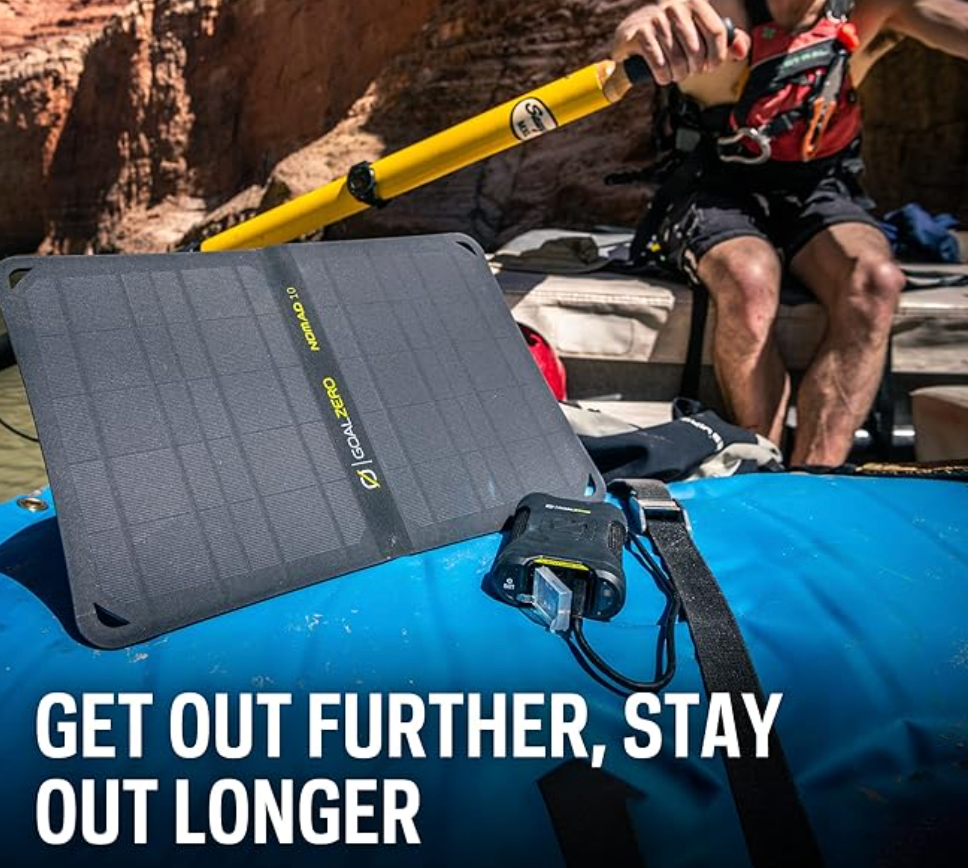
Goal Zero is the most established brand in outdoor solar power and the Nomad 20 is their benchmark foldable solar panel for trekking and expedition use. At 20W output with a weatherproof construction (IPX4 weather resistance — splash-proof in rain), the Nomad 20 handles the variable conditions of Andes trekking better than non-rated panels. The proprietary Goal Zero port connects directly to Yeti power stations for expedition base camp operations; the USB-A port with auto-restart technology continues charging after cloud interruptions automatically. For photographer-trekkers who also use a Goal Zero Yeti power station at base camp, the Nomad 20 is the natural solar charging partner.

Wattage: 20W peakWeather Resistance: IPX4 — splash-proofPorts: 1x Goal Zero port + 1x USB-AWeight: 510gCompatibility: Goal Zero ecosystem + universal USB
  • +IPX4 weather resistance — splash-proof in rain, unlike most unrated panels
  • +Auto-restart charging — resumes automatically after cloud interruption
  • +Goal Zero ecosystem compatibility — pairs with Yeti power stations
  • +Rugged construction — the most durable panel in this guide for rough conditions
  • +Best for base camp photography operations with Goal Zero power station setup
Check Price on Amazon

As an Amazon Associate, Uncover the Andes earns from qualifying purchases at no extra cost to you.

Best Portable Solar Panels for Andes & Patagonia Trekking
BEST HIGH-WATTAGE

Jackery SolarSaga 100W Solar Panel

When base camp operations need serious power — 100W in a foldable expedition panel.

The Jackery SolarSaga 100W is a different category of solar panel from the rest of this guide — it is designed for base camp use and vehicle-supported expeditions rather than backpacking. At 100W output and 4.6 kg, you will not be clipping this to a Salkantay pack. But for film production expeditions in Bolivia, multi-week vehicle-supported photography operations in the Peruvian highlands, or any base camp setup where substantial continuous power generation is required, the SolarSaga 100W generates enough electricity to power a Jackery Explorer 240 power station (or similar) from empty to full in under 3 hours of direct altiplano sun. It folds to a manageable suitcase-format and fits in a vehicle cargo area.

Wattage: 100W peakEfficiency: 23% monocrystallinePorts: 2x USB-A + 1x DC outputWeight: 4.6 kgBest For: Base camp, vehicle-supported expeditions
  • +100W — generates enough power for full base camp operations at altitude
  • +23% monocrystalline efficiency — highest conversion rate in this guide
  • +Charges Jackery Explorer 240 from empty in under 3 hours at 4000m altitude
  • +Vehicle-friendly folded format — fits in SUV cargo area for supported expeditions
  • +Best for Bolivia film production, multi-week photography base camp operations
Check Price on Amazon

As an Amazon Associate, Uncover the Andes earns from qualifying purchases at no extra cost to you.

BEST BUDGET

Renogy E.FLEX 21 Portable Solar Panel

Renogy’s residential solar expertise in a carry-on-legal trail format at a competitive price.

Renogy is one of the largest residential solar panel manufacturers in the United States, and the E.FLEX 21 brings their panel manufacturing expertise to the portable travel format at a price point below most comparable-wattage alternatives. The 21W monocrystalline panel delivers reliable output in the same conditions as the BigBlue and Anker options, with Renogy’s reputation for consistent panel quality at the back of it. The E.FLEX 21 uses a USB-C and USB-A dual output with Smart Charging IC — the same technology that makes the BigBlue 28W effective. At 480g and significantly below the BigBlue price, it is the best value-per-watt option in this guide for trekkers who want solid solar performance without the premium branding cost.

Wattage: 21W peakPorts: 1x USB-C + 1x USB-A (Smart IC)Weight: 480gEfficiency: 21–22% monocrystallinePrice: Best value-per-watt in guide
  • +Renogy residential solar manufacturing quality in a portable format
  • +USB-C output — charges USB-C laptops, cameras, and modern phones natively
  • +Smart Charging IC — optimal current delivery regardless of device type
  • +Best value-per-watt option — Renogy manufacturing scale keeps price competitive
  • +Compact folded profile — clips to pack exterior without interfering with pack access
Check Price on Amazon

As an Amazon Associate, Uncover the Andes earns from qualifying purchases at no extra cost to you.

Best Portable Solar Panels for Andes & Patagonia Trekking

How to Mount and Use a Solar Panel on the Trail: The Andes-Specific Setup

A solar panel in your pack generates zero power. The efficiency advantage of Andes altitude is only realised when the panel is deployed and facing the sun. Getting the mounting setup right makes the difference between a solar panel that meaningfully extends your off-grid capability and one that adds weight without contributing power.

Clipping to pack exterior

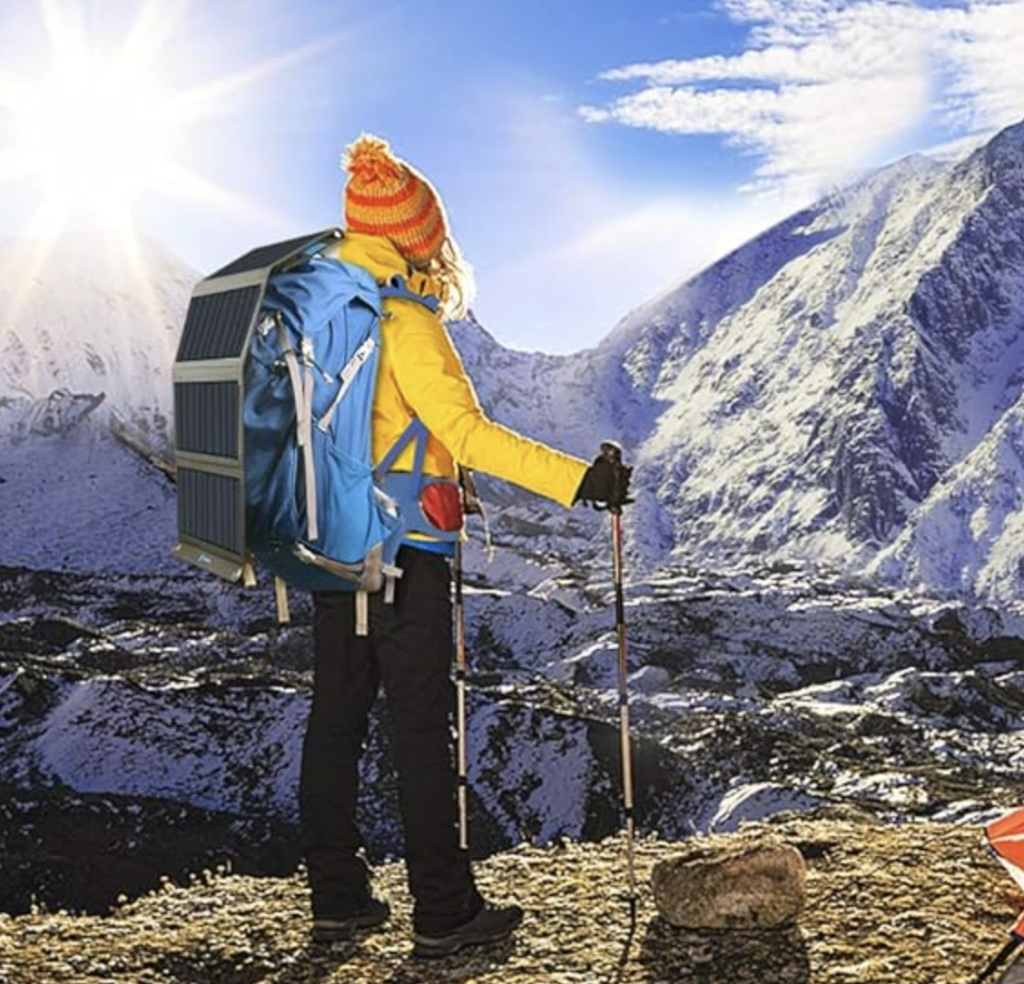
The most common setup: attach the panel to the back panel or top lid of your trekking pack using the integrated loops and carabiners that most foldable solar panels include. Face the panel toward the sun as you trek. On north-south oriented trails (common on the Inca Trail and Salkantay), position the panel on the side of your pack facing the sun based on time of day — the east-facing side in the morning, flat on top or west-facing in the afternoon. At Andes latitudes (10–23 degrees south), the sun tracks north of you for most of the day — face the panel northward for maximum exposure.

Optimal tilt angle at Andes latitudes

Solar panels generate maximum output when perpendicular to the sun’s rays. At the latitude of Cusco (13°S) and La Paz (16°S), the optimal fixed tilt angle is approximately 13–16 degrees from horizontal, facing north. Most trekking packs sit at approximately 10–15 degrees from vertical when on your back — which coincidentally provides close to optimal tilt for midday solar charging at Andes latitudes. No precise adjustment is needed for midday trekking; adjust manually during morning and afternoon hours when the sun angle is lower.

While at rest or camp

During lunch breaks and camp time, prop the panel at optimal angle using rocks, trekking poles, or the BioLite SolarPanel’s integrated kickstand. A 30-minute high-sun lunch break on the Bolivian altiplano with a 28W panel generates approximately 8–12 Wh of usable charge — roughly 15–20% of a smartphone battery. Consistent use of every available sun window compounds meaningfully over a multi-day trek.

Pairing Solar Panels with Power Banks: The Complete Off-Grid Power System

The most effective off-grid power system for Andes and Patagonia trekking pairs a portable solar panel with a high-capacity power bank. The solar panel generates power during the trekking day; the power bank stores it and delivers it to devices on demand. Understanding the input/output dynamics between the two components helps you match them correctly.

Panel wattage vs bank input rate: Most power banks accept a maximum USB input of 18–25W. A 28W solar panel generating at full output will be throttled to the bank’s maximum input rate — approximately 18W for most 20,000 mAh banks. This is fine; the panel rating is a peak value under optimal conditions, and real-world output with cloud variability is typically 60–70% of rated wattage. A 28W panel average real-world output of 18–20W matches perfectly to a 20,000 mAh bank’s 18W input limit.

Calculating daily charge generated: A 21W panel trekking for 8 hours of sun on the Bolivian altiplano at approximately 60% average efficiency = 21W x 0.6 x 8 hours = approximately 101 Wh of energy generated. A 20,000 mAh power bank at 3.7V holds 74 Wh at full capacity. On a clear altiplano day, a 21W panel generates enough energy to fully charge a 20,000 mAh bank with spare capacity — meaning the bank stays full or near-full every day of the crossing, regardless of how much you use overnight.

GEAR GUIDE

Best Insulation Jackets for Andes and Patagonia Trekking 2026

Cold mornings on the altiplano require the right insulation — the companion gear guide to staying warm while your solar panel charges.

Read the Guide

The Best Solar-Optimised Andes Routes: Where to Use Your Panel Most Effectively

Not all Andes routes offer equally good solar charging conditions. Route selection — or at least understanding the solar profile of your chosen route — helps you decide how much panel capacity to carry and whether solar supplementation is a meaningful part of your power strategy.

RouteSolar ReliabilityBest MonthsPanel RecommendationExpected Daily Charge
Bolivian Altiplano / Salar de UyuniExcellent — 10–12 hrs direct sun dailyMay–October (dry season)21W+ panel — primary power supplementFull 20,000 mAh bank recharge daily
Inca Trail Classic (4-day)Moderate — cloud forest reduces sunMay–September21W panel — useful on exposed sections50–70% bank recharge per day
Salkantay Trek (5-day)Good above cloud forest, variable belowApril–October21W panel — clip to pack on high sections60–80% bank recharge above 3500m
Choquequirao (4–5 day)Good — exposed trail in dry seasonMay–September21W panel recommended70–90% bank recharge in clear conditions
Cordillera Blanca (Peru)Excellent above 3500m in dry seasonJune–August28W panel for max outputFull bank recharge most days
Torres del Paine W CircuitPoor — cloud and rain 50%+ of daysDec–Feb (peak)Power bank primary; solar as bonus only10–40% bank recharge on clear days only
Solar charging potential by Andes and Patagonia trekking route.

The most important

Takeaway from this table: if your route is exclusively in Patagonia, the weight of a solar panel may not be justified unless you are also doing a Bolivia or Peru section on the same trip. If your route includes the Bolivian altiplano in dry season, a solar panel is one of the most useful pieces of gear in your bag — it effectively makes your power system unlimited for the duration of the crossing.

GEAR GUIDE

Best High-Altitude Trekking Boots for the Andes 2026

The boots that carry you across the solar-rich altiplano — reviewed for Bolivia, Peru, and the Salkantay.
Read the Guide
Best Portable Solar Panels for Andes & Patagonia Trekking
TRAVEL INSURANCE

Your power gear is sorted. Is your insurance?

Electronics loss, theft, and trip interruption are real risks on South America travel. Two solid policies below.

Asegura Tu Viaje

Electronics theft, trip cancellation, and medical evacuation. Strong Andean and Latin American coverage network.

Get a Quote

IATI Seguros

International adventure travel insurer — covers camera gear, electronics, emergency repatriation, and high-altitude trekking incidents.

Get a Quote

Solar Panel Durability and Care in Andes Conditions

Portable solar panels face specific abuse on Andes trekking routes: UV radiation at altitude is intense enough to degrade unprotected materials faster than at sea level; temperature swings between midday sun (35°C panel surface) and overnight cold (-5°C) stress adhesive bonds between panel layers; and the dust of the Bolivian altiplano is abrasive and electrostatically attracted to panel surfaces.

Cleaning panels at altitude: Dust accumulation on the panel surface reduces output by 5–15% depending on density. Clean panel surfaces with a soft, damp cloth — not a dry cloth, which grinds abrasive dust particles across the panel surface. In the field, breathing moisture onto the panel face and wiping gently with a microfibre cloth (the same one you use for your camera lens) is the correct technique. Clean before each day’s charging session for maximum output.

Storage between uses: Fold panels fully and store in the included protective sleeve when not deployed. Never store panels folded with sharp objects against the panel face — the monocrystalline cells crack from point pressure and cracked cells permanently reduce output. Roll cables loosely rather than tight-coiling, which stresses the cable sheath at the connection points.

Rain exposure: Most panels in this guide are not waterproof — they are splash-resistant at best (BigBlue, Anker, Renogy) or IPX4 rated (Goal Zero Nomad 20). In sustained Andean rain, remove the panel from the pack exterior and store it in the main compartment or a waterproof dry bag. Do not attempt to charge devices in heavy rain even from IPX4-rated panels — water in USB ports causes corrosion damage to both the panel output port and the device charging port.
Best Portable Solar Panels for Andes & Patagonia Trekking
FAQ

Frequently Asked Questions

What is the best portable solar panel for the Bolivian altiplano?

The BigBlue 28W is the best all-round choice for the Bolivian altiplano. Its 28W output takes full advantage of the high-altitude solar intensity, the three USB-A ports allow simultaneous charging of multiple devices, and the Smart IC chip maintains optimal charging current throughout the day. For trekkers who want the lightest option with meaningful output, the Anker 21W at 400g is the best weight-conscious alternative.

Do solar panels work in Patagonia?

Poorly and unreliably. The Torres del Paine W Circuit has cloud cover and rain on 50%+ of trekking days in peak season. A 21W panel under full Patagonian overcast generates 1–3W of actual output — barely enough to maintain phone charge, not enough for meaningful power bank charging. For Patagonia, carry a high-capacity power bank as your primary power source and treat a solar panel as an opportunistic supplement on the occasional clear day.

How do I attach a solar panel to my trekking pack?

Most foldable solar panels include integrated D-ring loops and either a short carabiner or bungee cord for pack attachment. Loop the carabiner or bungee through the pack’s top handle or external lashing points and clip the panel to the back panel or top lid, facing away from the pack (outward, toward the sun). Angle the panel toward the sun based on time of day. The pack’s natural lean when worn provides approximately the right tilt for midday charging at Andes latitudes.

What wattage solar panel do I need to charge a power bank?

A 21W panel is the minimum for meaningful power bank charging during a trekking day. At 60% real-world efficiency and 8 hours of Andes sun, a 21W panel generates approximately 100 Wh — enough to fully charge a 20,000 mAh (74 Wh) power bank. A 28W panel provides comfortable margin. Panels under 15W generate insufficient power to keep ahead of daily device consumption for a trekker with both phone and camera.

Can I charge USB-C devices directly from a solar panel?

Most solar panels in this guide output USB-A. The BigBlue 28W and Renogy E.FLEX 21 include USB-C output ports. To charge USB-C devices from a USB-A solar panel, use a USB-A to USB-C cable — these are widely available and charge at standard (non-fast) speeds. For fast charging, you need either a USB-C solar panel output or a power bank with fast-charge USB-C as an intermediary.

Will a solar panel damage my camera batteries?

No — solar panels output regulated DC voltage through USB ports, and camera charging adapters (USB-C to camera battery charger) regulate the input to safe charging parameters. The solar panel’s Smart IC charging technology prevents overcharging and voltage spikes that could damage battery cells. Always use the original camera manufacturer’s charging cable or a quality third-party equivalent rather than cheap generic cables.

How much does altitude improve solar panel output?

At 4,000 metres in clear conditions, a solar panel generates approximately 15–20% more power than its sea-level rated wattage. A 21W rated panel generates 24–25W actual output at 4,000m in clear Bolivian altiplano conditions. This is because thinner atmosphere at altitude means less solar radiation is scattered and absorbed before reaching the panel surface. The UV intensity increase further improves output on some panel technologies.

Can I leave a solar panel deployed overnight?

No — solar panels generate power only from light. Leaving them deployed overnight does not charge devices or harm the panel, but it exposes them to dew and condensation that can enter connection ports. Always fold and store panels in their protective sleeve overnight to prevent moisture damage to the panel surface and output ports.

What is the best solar panel for a photographer on the Inca Trail?

The Anker 21W for its combination of 400g weight (minimal burden on an already heavy photography pack), reliable PowerIQ adaptive charging, and Anker quality. Clip it to the back of your pack and run a USB cable into your hip belt where the power bank lives — your mirrorless camera batteries charge continuously throughout the trekking day without stopping or removing the pack.

Do portable solar panels work on overcast days?

Yes, but output drops significantly. Under light overcast, a 21W panel generates approximately 30–40% of its rated output (6–8W). Under heavy overcast or in the shade, output drops to 5–15% (1–3W) — enough to maintain device charge but not enough to charge a depleted power bank meaningfully. For routes with reliable sun (Bolivian altiplano dry season, Peru dry season above 3,000m), solar is a viable primary power supplement. For Patagonia or any route with heavy cloud cover, a solar panel is a bonus at best.

FIND YOUR HOTEL

Hotels in La Paz, Uyuni, and Cusco — your solar trekking base cities. Book before the dry-season rush.

La Paz and Uyuni town are the base cities for the Bolivian altiplano solar trekking circuit. Cusco for Peru. Book accommodation for your arrival and departure nights.

Prices shown include all taxes. Booking through this link supports Uncover the Andes at no extra cost to you.

Conclusion: Solar Power on the Andes Is Not a Gimmick — It Is a System

Three years ago, portable solar panels were novelty items — too heavy, too inefficient, too dependent on perfect conditions to be practical trail tools. The panels available in 2026 are genuinely different. A 21W panel at 400g generating 24W of actual output on the Bolivian altiplano, clipped to your pack while you walk, charging a power bank that charges your camera batteries and phone throughout the day — this is a real system that real expedition photographers and trekkers rely on.

The key is matching the system to the route. Bolivia dry season: solar panels are outstanding. Patagonia: carry a high-capacity power bank and treat the solar panel as a bonus. The Inca Trail cloud forest: somewhere in between — a solar panel helps on clear sections but cannot be relied upon on cloudy days. Know your route’s solar potential before you decide how much weight to commit to the system.

The full power management guide at Uncover the Andes — power banks, solar panels, cables, and city charging strategy — is linked throughout this article. The rest of the Gear Lab Hub covers boots, layering, backpacks, and destination guides for every major Andes and Patagonia route. Everything connects. See you under the altiplano sun.


Join the Conversation

Leave a Reply

Your email address will not be published. Required fields are marked *

Close
Close