Disclosure: this guide contains affiliate links. If you book or buy through them we may earn a small commission at no extra cost to you, which helps keep Uncover the Andes independent.
Bogotá has a reputation problem. For years travelers flew in, glanced at the gray skies and the traffic, and caught the next flight to Medellín or Cartagena. Those who stayed found something very different: a high Andean capital at 2,640 meters with a beautifully preserved colonial quarter, one of the world’s great museums of pre-Columbian gold, a food scene that now rivals any city in Latin America, and green mountains rising straight above the skyscrapers.
This 2026 guide covers everything you need for a first visit: the best neighborhoods to stay in, the top things to do with current prices, how to deal with the altitude, getting around on TransMilenio and apps, the best day trips including the Zipaquirá Salt Cathedral, an honest look at safety, a three-day itinerary and a realistic budget. Before you fly, check the latest Colombia entry requirements and Check-Mig form.
Bogotá at a Glance
Bogotá is Colombia’s capital and largest city, with around eight million people in the city itself. It sits on a high plateau, the Sabana de Bogotá, in the Eastern Cordillera of the Andes. The city runs north to south along the foot of the Monserrate and Guadalupe hills, which makes orientation easy: the mountains are always to the east. Street numbers are logical too. Calles run east to west and increase as you go north, and Carreras run north to south and increase as you go west.
| Key fact | Details |
|---|---|
| Altitude | 2,640 m above sea level |
| Climate | Cool all year, average around 14 °C, frequent afternoon showers |
| Currency | Colombian peso (COP); cards widely accepted |
| Airport | El Dorado International (BOG), about 15 km west of the center |
| Public transport fare | TransMilenio and SITP COP 3,550 since 14 January 2026 |
| Plugs | Type A and B, 110 V |
| Time needed | 3 days, plus 1 for a day trip |
Dealing With the Altitude in Bogotá
At 2,640 meters, Bogotá is higher than any city in the Alps, though lower than Cusco or La Paz. Most visitors feel nothing more than mild breathlessness on stairs, a slight headache or poor sleep on the first night. Take the first day easy, drink plenty of water, go light on alcohol and save the steep Monserrate hike for your second or third day. If you are continuing to higher places in Peru or Bolivia later, read our altitude sickness guide for prevention tips.
Best Neighborhoods to Stay in Bogotá
La Candelaria
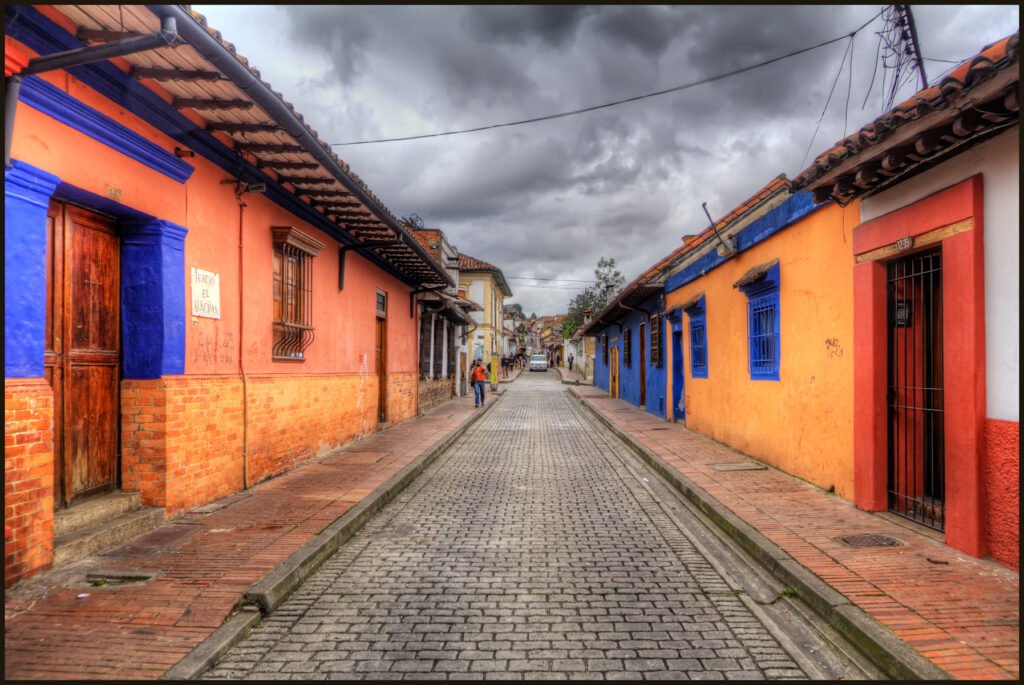
The historic center is where most backpackers stay, close to museums, Plaza de Bolívar and the start of the Monserrate trail. It is full of character, with colonial houses, murals and hostels, but it empties at night and some streets feel unsafe after dark. Stay here for convenience by day, and take a ride-hailing car when you go out in the evening.
Chapinero and Chapinero Alto
A large, diverse area north of the center. Chapinero Alto, close to the hills, has leafy streets, excellent restaurants, coffee shops and boutique hotels, and it is the heart of the city’s LGBTQ+ scene. It is a good balance of safety, character and location.
Zona G, Zona T and Parque 93
Further north, these upscale districts are packed with restaurants (Zona G stands for gourmet), bars, shopping and modern hotels. They are the safest and most comfortable areas, but the historic sights are a 30 to 45 minute ride away depending on traffic.
Usaquén
Once a separate colonial village, Usaquén is now part of the far north of the city. Its plaza, church and Sunday flea market make it a pleasant, relaxed base, especially for families and longer stays.
WHERE TO STAY IN BOGOTÁ
Choose between colonial and cosmopolitan
Compare hostels in La Candelaria, boutique hotels in Chapinero Alto and modern stays near Parque 93, with real reviews and free cancellation on most rooms.
✓ Free cancellation on most stays · ★ Verified guest reviews · ✓ Pay at the property options
Best Things to Do in Bogotá
Go up Monserrate
The white church of Monserrate sits at about 3,150 meters on the hill above the city, and the view from the top over the endless grid of Bogotá is the city’s signature experience. You have three ways up: the funicular, the cable car, or the pedestrian trail of roughly 1,500 steps, which takes most people 60 to 90 minutes. The trail is free but only open during set daytime hours and can close early when it reaches capacity, so start in the morning. Funicular and cable car tickets cost more on some days than others; recent fares for a single journey on peak days were around COP 21,000, so budget roughly COP 30,000 to 45,000 for a round trip, and check the official Monserrate website for the current rate.
Go early on a clear morning before clouds build, or late afternoon to watch the city lights come on. At the top there are restaurants, a small market selling snacks and the sanctuary of the Señor Caído, a pilgrimage site for Colombians.
Visit the Gold Museum
The Museo del Oro of the Banco de la República holds one of the largest collections of pre-Hispanic goldwork in the world, with tens of thousands of gold and metal objects from Colombia’s indigenous cultures. The highlight is the Muisca raft, a tiny gold sculpture that depicts the ceremony behind the legend of El Dorado. Entry has long cost only a few thousand pesos, with free entry on Sundays; it is closed on Mondays. Allow at least two hours.
Museo Botero and Casa de Moneda
Two blocks from the Gold Museum, the Museo Botero displays works by Fernando Botero, known for his rounded figures, alongside his personal collection of Picasso, Monet, Renoir and Dalí. Entry is free, as it is to the connected Casa de Moneda and the Banco de la República art collection. It is one of the best free cultural experiences in South America.
Explore La Candelaria and Plaza de Bolívar
Plaza de Bolívar is surrounded by the Cathedral, the Capitol, the Palace of Justice and the City Hall, and it has been the stage of Colombian history for centuries. From there, wander uphill through colorful streets to the Chorro de Quevedo, a tiny square said to be where the city was founded in 1538, now a lively spot with street performers and chicha vendors.
Take a graffiti tour
Bogotá is one of the world’s great street art cities, thanks partly to relaxed rules that encourage murals. Tip-based graffiti tours run daily in La Candelaria and explain the political and social stories behind the art. It is the best way to understand the city in a couple of hours.
Ride the Ciclovía on a Sunday
Every Sunday and public holiday from 7:00 to 14:00, more than 100 km of main roads close to cars and fill with cyclists, runners, skaters and families. Rent a bike or join a bike tour and ride north along Carrera Séptima to experience the city at its friendliest.
Eat at Paloquemao market and La Puerta Falsa
Paloquemao is Bogotá’s great food market, with exotic fruits you have never heard of, a flower market early in the morning and simple counters serving breakfast. Try lulo, granadilla, uchuva, mangostino and pitahaya. In La Candelaria, La Puerta Falsa has served tamales and chocolate con queso since 1816.
Usaquén Sunday market
On Sundays, the streets around the Usaquén plaza fill with craft stalls, food vendors and live music. It is the most relaxed corner of the city and a pleasant contrast to the bustle of the center.
| Attraction | Approx. price (2026) | Opening | Tip |
|---|---|---|---|
| Monserrate funicular or cable car | approx. COP 30,000-45,000 round trip, varies by day | Daily | Go early for clear views |
| Monserrate pedestrian trail | Free | Mornings and early afternoon, limited days | Start early, bring water |
| Museo del Oro | A few thousand COP; free on Sundays | Tue-Sun | Closed Mondays |
| Museo Botero and Casa de Moneda | Free | Closed Tuesdays | Combine with the Gold Museum |
| Graffiti tour | Tip-based or approx. USD 15-25 | Daily | Morning or afternoon |
| Zipaquirá Salt Cathedral | approx. COP 110,000-140,000 for foreigners | Daily | Weekdays are less crowded |
BOGOTÁ TOURS AND DAY TRIPS
See more of Bogotá with a local guide
Graffiti tours, bike tours, food tours and day trips to the Salt Cathedral and Guatavita, with free cancellation up to 24 hours before on most activities.
✓ Free cancellation on most tours · ★ Traveler reviews · ✓ Hotel pick-up options
Best Day Trips from Bogotá
Zipaquirá Salt Cathedral
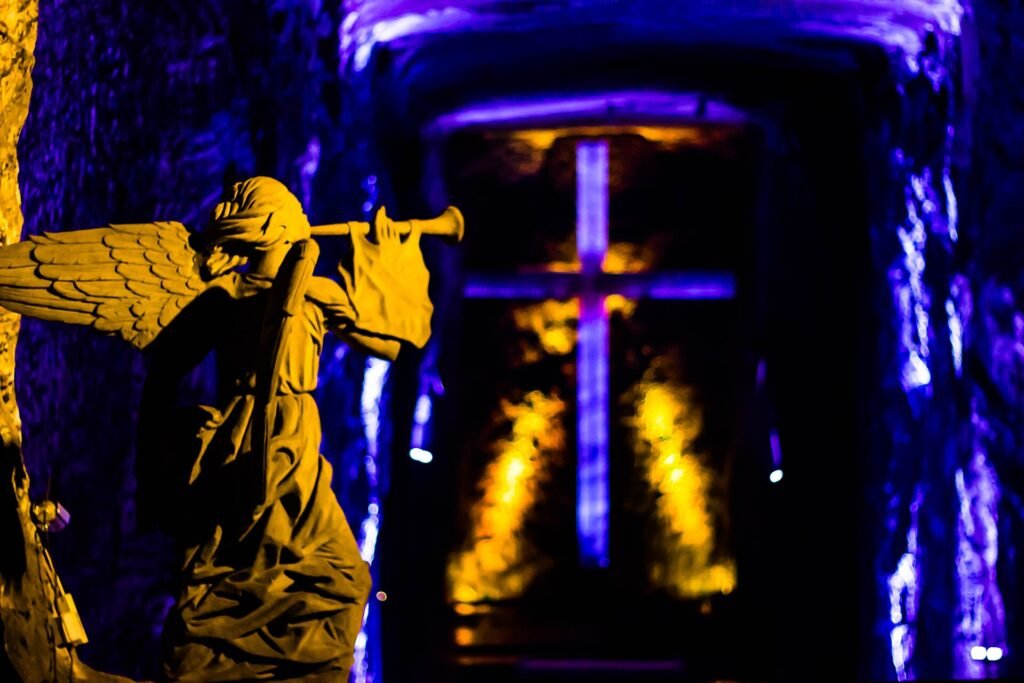
About 50 km north of Bogotá, the Catedral de Sal is an underground church carved inside a working salt mine, roughly 180 meters below the surface. You descend through the Stations of the Cross, each one a dramatic chamber lit in changing colors, to a vast main nave with a giant illuminated cross. It is one of Colombia’s most visited attractions and genuinely impressive even for non-religious travelers.
Ticket packages for foreigners have recently ranged from roughly COP 110,000 to 140,000 depending on what is included, with lower rates for Colombians. You can reach Zipaquirá by bus from the Portal Norte TransMilenio station in about an hour, or by tour. Walk around Zipaquirá’s colonial main square before heading back.
Laguna de Guatavita
This almost perfectly circular lagoon in the hills northeast of Bogotá was a sacred site for the Muisca people. Here, a new chief covered in gold dust is said to have floated out on a raft and offered gold to the gods, the ceremony that inspired the legend of El Dorado and centuries of failed treasure hunts. Today it is a protected reserve visited with a guide on a short trail. Many tours combine it with Zipaquirá in one day.
Villa de Leyva
Three to four hours north by road, Villa de Leyva is one of the best-preserved colonial towns in Colombia, with a vast cobbled main square, whitewashed houses and a dry, sunny climate. It is better as an overnight trip than a day trip, with fossils, vineyards and the Pozos Azules nearby.
Chingaza National Park
For hikers, Chingaza protects high-altitude páramo ecosystems east of the city, with frailejón plants, glacial lagoons and the water source for most of Bogotá. Visits require advance registration and usually a guide or tour, and trails sit above 3,000 meters, so dress warmly.
| Day trip | Distance from Bogotá | Travel time | Best for |
|---|---|---|---|
| Zipaquirá Salt Cathedral | about 50 km | 1-1.5 h | Underground cathedral, colonial town |
| Laguna de Guatavita | about 75 km | 1.5-2 h | Muisca history, El Dorado legend |
| Villa de Leyva | about 170 km | 3-4 h | Colonial architecture, overnight trip |
| Chingaza National Park | about 50-60 km | 2 h | Páramo hiking and lagoons |
| Suesca | about 60 km | 1.5 h | Rock climbing on sandstone cliffs |
Getting Around Bogotá
From El Dorado Airport
El Dorado is about 15 km from the center. Use the official taxi rank outside arrivals, where you receive a printed slip with the estimated fare, or a ride-hailing app from the designated pick-up area. Traffic can turn a 30 minute ride into 90 minutes at rush hour. Budget travelers can take feeder buses linking the airport to the TransMilenio network, but it is a struggle with luggage.
TransMilenio, SITP and ride-hailing
TransMilenio is Bogotá’s bus rapid transit system, with red articulated buses on dedicated lanes. It is cheap at COP 3,550 per trip in 2026, but it is very crowded at peak hours and a hotspot for pickpockets. Load a TuLlave card at stations. Blue SITP buses cover the rest of the city. For most visitors, ride-hailing apps are the safest and most convenient option, especially at night. Bogotá’s first metro line is under construction and is not expected to open to passengers before around 2028.
FLIGHTS AROUND COLOMBIA
Bogotá is the hub for every Colombian route
Domestic flights to Medellín, Cartagena, Santa Marta and Pereira for the Coffee Triangle often cost less than long bus journeys. Compare every airline and catch the cheapest dates with price alerts.
✓ Free price alerts · ✈ Domestic and international · ✓ No booking fees
Is Bogotá Safe for Tourists?
Bogotá is much safer than its reputation from the 1990s, and millions of visitors enjoy it without problems every year. Still, petty crime is common and you need to be streetwise. Colombians have a saying, no dar papaya, which means do not make yourself an easy target.
- Keep phones out of sight on the street and on TransMilenio. Phone theft is by far the most common crime.
- Use ride-hailing apps or official taxis at night, especially in La Candelaria.
- Never accept drinks, flyers or anything from strangers, and watch your drink in bars. Drugging with substances such as scopolamine is rare but real, particularly in dating-app meetups.
- Avoid walking alone on the Monserrate trail outside opening hours, and stay away from the hills above La Candelaria after dark.
- Carry a photocopy of your passport and leave the original in your hotel safe.
For region-by-region advice across the country, read our honest guide Is Colombia safe to travel in 2026.
TRAVEL INSURANCE FOR COLOMBIA
Theft, illness or a twisted ankle?
Private clinics in Bogotá are excellent but expect payment up front. SafetyWing covers emergency medical care across Colombia and the rest of South America, with monthly plans you can buy even after you have left home.
✓ Covers 180+ countries · ⚕ Emergency medical · ✓ Cancel anytime
Best Time to Visit Bogotá
Bogotá’s altitude gives it a cool, spring-like climate all year, with daytime highs around 18 to 20 °C and chilly nights that can drop to 5 to 8 °C. There are no real seasons in temperature, only in rainfall. The driest months are December to February and, to a lesser extent, July and August. The wettest are April, May, October and November, when afternoon downpours are almost daily. Even in the rainy season, mornings are often clear, so plan outdoor sights early.
Pack layers whatever the month: a light rain jacket, a warm sweater for the evenings and comfortable shoes for steep, uneven streets. Big events worth timing a trip around include Rock al Parque (one of Latin America’s largest free music festivals, usually in the second half of the year), the Ibero-American Theater Festival (held in some years around Easter) and the Christmas lights season in December.
How Much Does Bogotá Cost? A 2026 Budget
Bogotá is good value compared with Santiago or Buenos Aires, especially for food. A set lunch, called corrientazo or menú del día, with soup, a main course and a juice, still costs a fraction of a restaurant dinner.
| Expense | Budget | Mid-range | Comfort |
|---|---|---|---|
| Accommodation per night | Hostel dorm approx. USD 12-20 | Boutique hotel approx. USD 55-100 | Luxury hotel approx. USD 150+ |
| Meals per day | Set lunches and street food approx. USD 12-20 | Restaurants approx. USD 35-55 | Fine dining approx. USD 80+ |
| Transport per day | TransMilenio approx. USD 2-3 | Ride-hailing approx. USD 8-15 | Private driver approx. USD 60+ |
| Activities per day | Free museums, graffiti tour tips | Monserrate, Gold Museum approx. USD 15-25 | Private tours approx. USD 100+ |
| Daily total | approx. USD 30-50 | approx. USD 100-170 | approx. USD 300+ |
What to Eat in Bogotá
- Ajiaco santafereño: the city’s signature chicken and potato soup with corn, guascas herb, capers and cream, served with rice and avocado.
- Changua: a breakfast soup of milk, egg and scallions with a piece of bread soaking in it, more comforting than it sounds on a cold morning.
- Tamal tolimense and tamal santafereño: corn dough filled with meat and vegetables and steamed in plantain leaves.
- Chocolate con queso: hot chocolate with a slice of cheese melted into it, a Bogotá classic.
- Fresh juices: lulo, maracuyá, guanábana and mora, made with water or milk.
- Coffee: Bogotá has excellent specialty cafés roasting beans from the regions you can visit in the Coffee Triangle.
Sample 3-Day Bogotá Itinerary
- Day 1, the historic center: Plaza de Bolívar, the Gold Museum, Museo Botero and Casa de Moneda. Afternoon graffiti tour, then lunch or an early dinner at La Puerta Falsa and a sunset drink near Chorro de Quevedo.
- Day 2, Monserrate and the north: Climb or ride up Monserrate early, then head north for lunch in Zona G, the Parque 93 area in the afternoon and dinner in Chapinero Alto.
- Day 3, Salt Cathedral: Day trip to Zipaquirá, adding Guatavita if you are on a tour. On a Sunday, swap in the Ciclovía and the Usaquén market.
From Bogotá, most travelers fly to Medellín, Cartagena or the Coffee Triangle. Our 10-day Colombia itinerary shows how to connect them, and the Medellín airport transfer guide helps on arrival there.
✓ Guidebook we use
Lonely Planet Colombia (latest edition)
Detailed maps of Bogotá’s neighborhoods plus Medellín, Cartagena, the Coffee Triangle and the Lost City trek, with itineraries that help you link the country’s regions efficiently.
As an Amazon Associate we earn from qualifying purchases.
Bogotá Travel FAQs
Is Bogotá worth visiting?
Yes. Bogotá has a beautiful colonial quarter, the world-class Gold Museum, free Botero collections, a strong food scene and day trips such as the Zipaquirá Salt Cathedral. Plan at least three days.
How many days do you need in Bogotá?
Three days covers the historic center, Monserrate, the museums and a day trip to Zipaquirá. Add a fourth day for Guatavita or an overnight trip to Villa de Leyva.
Will I get altitude sickness in Bogotá?
Most visitors only notice mild breathlessness or a headache at 2,640 meters. Rest on the first day, drink water, limit alcohol and leave the Monserrate hike for day two or three.
What is the best area to stay in Bogotá?
Chapinero Alto offers a good balance of safety, restaurants and location. La Candelaria is best for sightseeing on a budget, while Zona G, Zona T and Parque 93 are the safest and most upscale areas.
How much does it cost to go up Monserrate?
The pedestrian trail is free. Funicular and cable car fares vary by day; recent peak-day fares were around COP 21,000 per journey, so budget roughly COP 30,000 to 45,000 for a round trip.
Is the Gold Museum free?
The Museo del Oro charges a small entry fee most days and is free on Sundays. It is closed on Mondays.
How do I get from Bogotá to the Salt Cathedral?
Take TransMilenio to Portal Norte, then an intercity bus to Zipaquirá, about one hour, and walk to the cathedral. Many tours also include transport and Guatavita.
Is Bogotá safe at night?
The northern districts such as Zona G, Zona T and Parque 93 are lively and relatively safe at night. Avoid walking in La Candelaria and the center after dark and use ride-hailing apps.
What is the weather like in Bogotá?
Cool all year, with daytime highs around 18 to 20 °C and cold nights. December to February is driest, while April, May, October and November are the rainiest months.
How much is a TransMilenio ticket in 2026?
A TransMilenio or SITP trip costs COP 3,550 since 14 January 2026, paid with a rechargeable TuLlave card.
FLIGHT DELAYED? CANCELLED?
Arrived late in Bogotá? Claim what you are owed
If your flight to or from Colombia via the US or Europe was delayed, cancelled or overbooked, AirHelp checks whether you can claim up to 600 EUR in compensation, even for flights from the past few years.
✓ No win, no fee · ⚖ Millions of passengers helped · ✓ Free 2-minute check
Final Thoughts: Bogotá Deserves More Than a Stopover
Bogotá is not the easiest city in South America to love at first sight, but it rewards anyone who gives it a few days. Ride up Monserrate on a clear morning, lose yourself among the gold of the Muisca, follow the murals of La Candelaria and finish with a bowl of ajiaco on a chilly evening, and you will understand why so many travelers end up extending their stay.
Book your base in Chapinero Alto or La Candelaria, reserve the Salt Cathedral trip for your third day and keep a Sunday free for the Ciclovía. Then continue your journey with our master Colombia travel guide, or head north to the Caribbean for the Lost City trek.