
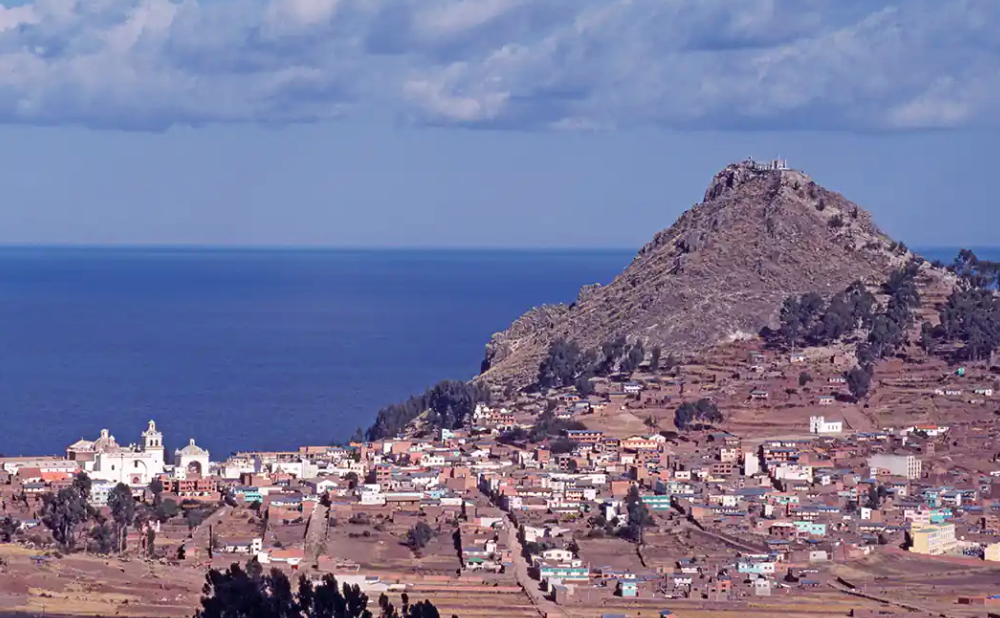
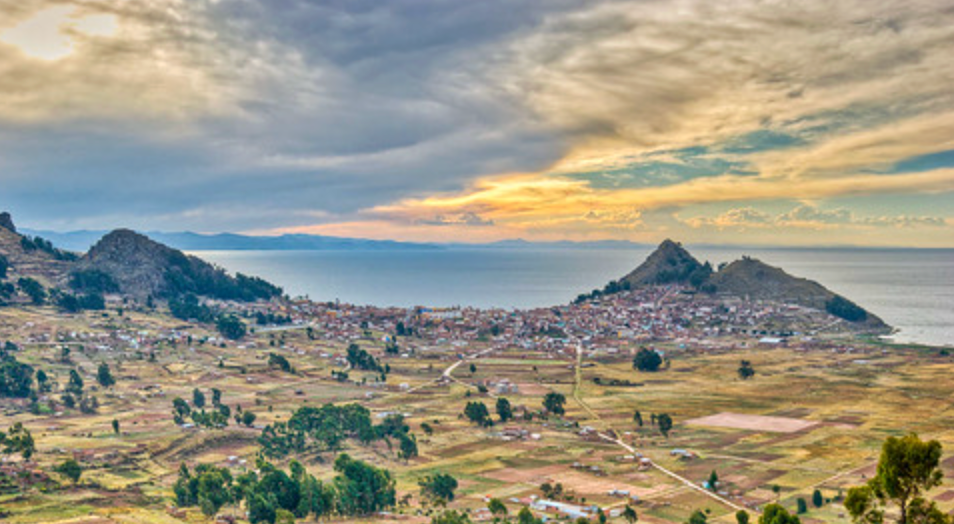
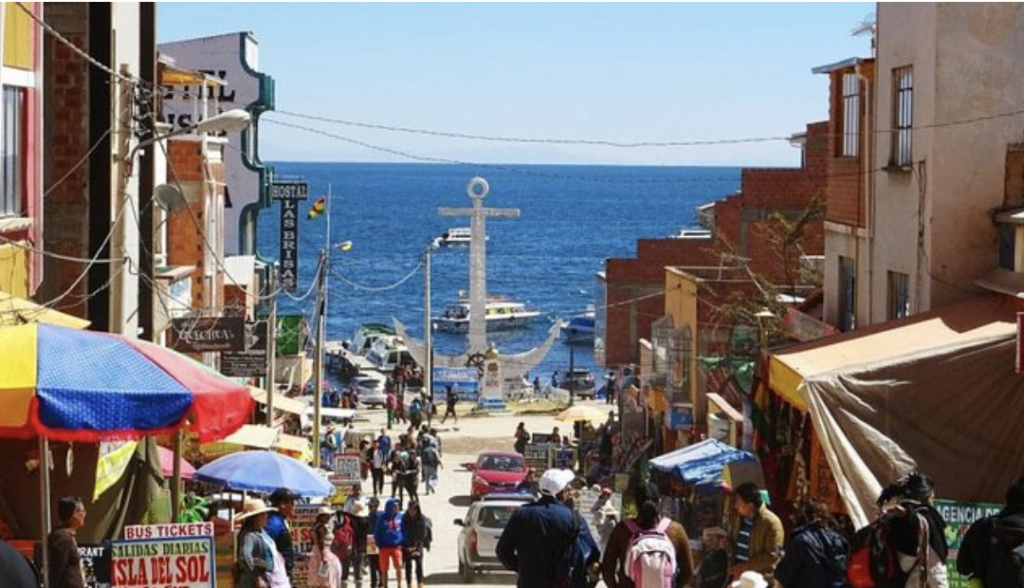
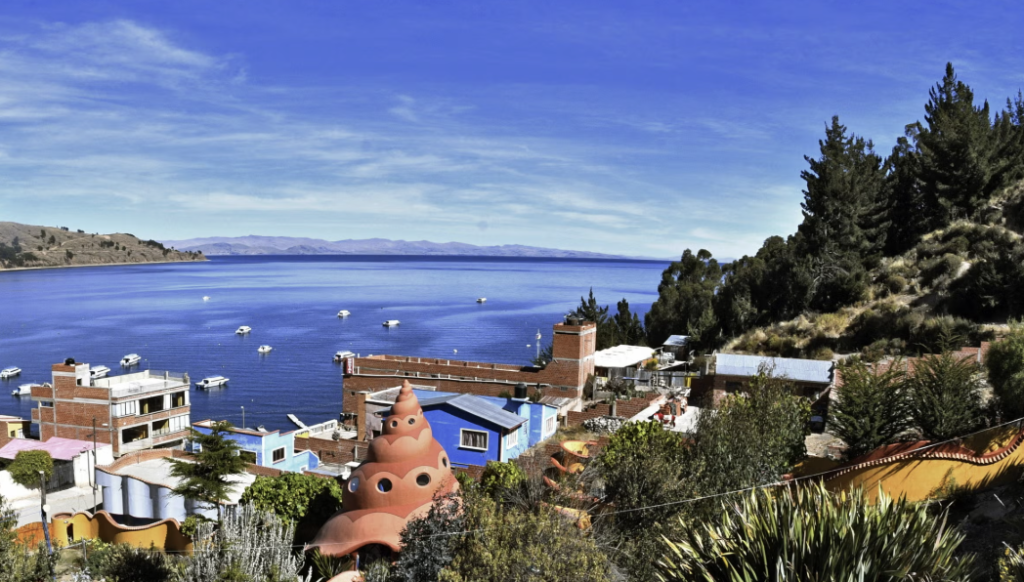
Copacabana sits on the southern shore of Lake Titicaca at 3,841 metres above sea level, wedged between two hills with the vast blue of the highest navigable lake in the world stretching to the horizon in every direction. It is a small town — barely 15,000 people — but it punches far above its weight. It is the spiritual heart of Bolivia, the gateway to the sacred Isla del Sol, one of the most photographed sunsets in South America, and the place where Bolivians bring their cars, tuk-tuks, and trucks to be blessed by a Catholic priest every single weekend.
If you are travelling the Andes — from Peru into Bolivia or vice versa — Copacabana is not optional. It is the crossing point between Puno and La Paz, it holds one of the most important Marian shrines in South America, and it sits at the edge of a lake so large and so high that it creates its own microclimate and looks more like a sea than anything you expect to find in a landlocked country. This guide covers everything you need to know to visit in 2026.
What Makes Copacabana Worth Your Time
Many travellers pass through Copacabana in a single day — bus from Puno, a quick look at the cathedral, bus to La Paz. That is a mistake. The town rewards at least two nights, ideally three. Spend the extra time and you get: a full day on Isla del Sol with the ruins and the sacred rock; a sunrise from Cerro Calvario with the lake on fire below you; a slow afternoon of trout, cold beer, and watching the local blessing ceremonies unfold on the church steps. Copacabana is not Instagram scenery — it is one of the genuinely living sacred sites of the Andes.
The town also has a strategic advantage for the serious traveller. It sits roughly midway on the classic Cusco-La Paz overland route, and almost every traveller making that journey stops here. That means good infrastructure for a Bolivian town of its size: reliable hostels and guesthouses, decent restaurants specialising in fresh trout, a functioning ATM (though it runs out on festival weekends — bring cash from La Paz), and multiple daily boat departures to the islands.
| Quick Facts | Detail |
|---|---|
| Location | Lake Titicaca, La Paz Department, Bolivia |
| Altitude | 3,841 metres (12,602 feet) above sea level |
| Population | ~15,000 |
| Distance from La Paz | 155 km (3–3.5 hours by bus) |
| Distance from Puno, Peru | 148 km (3.5–4 hours by bus + ferry) |
| Main attractions | Basilica, Isla del Sol, Isla de la Luna, Cerro Calvario, Titicaca sunsets |
| Peak season | June–September (dry season); August 5–6 (festival) — extremely crowded |
| Currency | Bolivian Boliviano (BOB) — USD not widely accepted |
| ATM | One ATM in town; can run dry on weekends. Bring cash. |
| Best time to visit | May–September for dry weather; avoid August 5–6 unless you want the festival crowds |
How to Get to Copacabana: From La Paz, Puno and Beyond
Copacabana is well-connected by road — but the journey involves a ferry crossing that surprises most first-timers. There is no bridge across the Strait of Tiquina, the narrow channel that separates the Copacabana peninsula from the rest of Bolivia. Buses load passengers onto small wooden ferries (passengers and bus separately) and cross in about 10 minutes. It is entirely normal, happens dozens of times a day, and is part of the experience — but the crossing adds time and a small cost to every journey.
From La Paz
Direct buses from La Paz to Copacabana depart from the Terminal de Buses in Zona Villa Fátima and take 3 to 3.5 hours. Multiple operators run the route — Titicaca Bus, Diana Tours, and Trans Copacabana among others. Fares are USD 3–5 one way. Buses depart roughly every hour from 7am to 2pm. The Tiquina crossing adds about 30 minutes and costs BOB 2 per passenger plus BOB 20–25 for the vehicle. Seats on the bus are not assigned — arrive 20 minutes before departure to get a window seat on the left side, which has better lake views on the final approach to Copacabana.
From Puno, Peru
The Puno to Copacabana route is one of the classic Andean overland crossings. Tourist buses depart Puno daily at around 7:30am and arrive in Copacabana by 12–1pm, crossing the Peru-Bolivia border at Kasani. Total journey: 3.5 to 4 hours including border formalities. The border crossing at Kasani is straightforward — exit Peru, walk 100 metres, enter Bolivia. Bolivian entry for US, EU, UK, and most nationalities is visa-free for up to 90 days. A reciprocity fee that previously applied to US citizens was abolished in 2018 and has not been reinstated.
Direct La Paz to Copacabana Onward to Cusco or Puno
Several operators run a La Paz-Copacabana-Puno direct tourist service. You board in La Paz, stop in Copacabana for about 1.5 hours (enough for the cathedral and lunch), then continue to Puno. This is efficient but you see almost nothing. We strongly recommend stopping for at least two nights in Copacabana — take a separate bus onward the next day.
| Route | Duration | Cost (approx) | Operator / Notes |
|---|---|---|---|
| La Paz to Copacabana | 3–3.5 hours | USD 3–5 | Multiple operators from Villa Fatima terminal; includes Tiquina ferry |
| Puno (Peru) to Copacabana | 3.5–4 hours | USD 7–12 | Tourist buses; border crossing at Kasani included |
| Cusco to Copacabana (direct) | 9–10 hours | USD 20–35 | Overnight or day bus; changes at Puno or direct tourist service |
| Copacabana to La Paz | 3–3.5 hours | USD 3–5 | Same operators; last bus departs approx 4pm |
| Copacabana to Puno | 3.5–4 hours | USD 7–12 | Morning departures only; book day before |
Machu Picchu, Salar de Uyuni and Copacabana: The Andes Trilogy
Planning the full Peru-Bolivia circuit? Our flagship guide covers all three destinations in one itinerary — including the Uyuni-to-Copacabana route.
The Basilica of Our Lady of Copacabana: Why It Matters
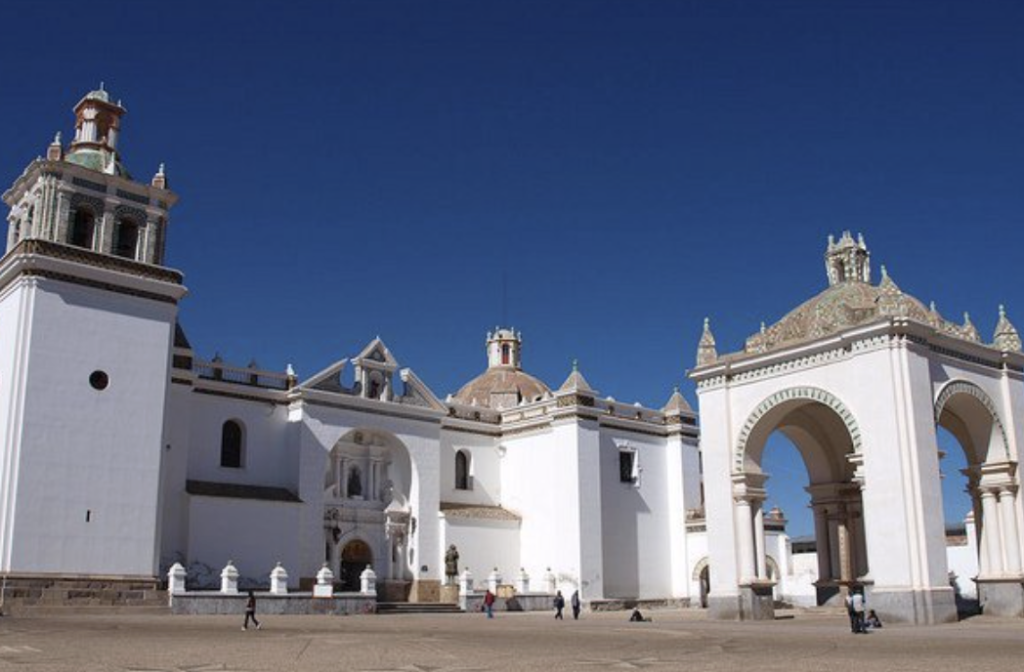
The Basilica of Our Lady of Copacabana is not simply a church — it is one of the most significant Marian pilgrimage sites in all of South America. The dark-skinned statue of the Virgin of Copacabana, carved by Tito Yupanqui in the 16th century, draws hundreds of thousands of pilgrims every year. The basilica itself — a striking white Moorish-influenced structure with blue cupolas — dominates the town and is visible from almost everywhere in Copacabana.
The forecourt of the basilica is where the famous blessing of cars (challa de autos) takes place. Every Saturday and Sunday, Bolivians line up their vehicles — decorated with flowers, streamers, and miniature symbols of what they hope to purchase — to receive a blessing from a priest and have a bottle of beer (or champagne, for the aspirational) sprinkled over the hood. It is chaotic, colourful, deeply sincere, and one of the great free spectacles in Bolivia. Plan to spend at least 45 minutes watching it.
The interior of the basilica houses the original statue and a museum of offerings brought by the faithful over four centuries — a deeply human collection of crutches, medals, photos, and handwritten notes. Entry to the church is free. The museum charges a small fee (BOB 5–10).
Isla del Sol: The Sacred Island of the Inca Sun God
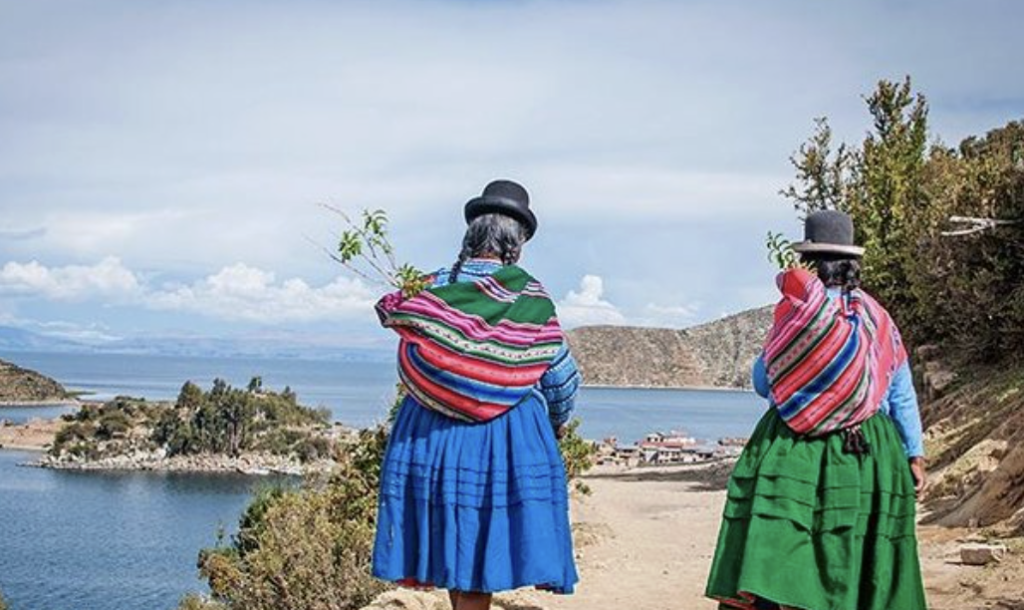
Isla del Sol is the reason most people come to Copacabana. It is the largest island on Lake Titicaca — 8 kilometres long, home to around 800 families — and according to Inca cosmology, it is the birthplace of the sun itself. The ruins scattered across its terraced hillsides include some of the finest pre-Inca and Inca stonework in Bolivia, and the views of the lake from the ridge trails are among the most spectacular in the entire Andes.
Getting There
Boats to Isla del Sol depart from Copacabana’s main jetty twice daily: 8:30am (recommended — gives you the full day) and 1:30pm. The journey to the north end of the island takes about 1.5 hours; to the south end, about 1 hour. Return boats leave the island in the afternoon (typically 3pm and 4:30pm from the south, 4pm from the north). Round-trip boat tickets cost approximately BOB 40–50 (USD 5–7). Buy tickets at the jetty the morning of departure — no advance booking required for the standard service.
The 2026 Situation: North End Access
This is critical information that most travel websites do not have. Since 2019, a dispute between the northern and southern communities of Isla del Sol has restricted tourist access to the north end of the island, including the famous Sacred Rock (La Roca Sagrada) and the Chincana ruins. As of May 2026, the situation remains unresolved. Tourists have been turned back and in some cases caught in confrontations between communities. Boat operators in Copacabana will tell you access is open — ask specifically whether the north is currently accessible and safe before buying a ticket. The south end of the island (Yumani, with its Inca staircase, spring, and ridge trail) is fully accessible and genuinely beautiful. A south-only day trip is a complete and worthwhile experience.
| Area | Status (May 2026) | Key Sites | Notes |
|---|---|---|---|
| South end (Yumani) | Open — fully accessible | Inca staircase, sacred spring, ridge trail, Pilko Kaina temple | Best sunset views on the island; most restaurants here |
| North end (Challapampa) | Disputed — verify before going | Sacred Rock, Chincana ruins, Museo Litico | Check current situation with boat operators on day of travel |
| Ridge trail (full crossing) | Partially restricted | Panoramic Titicaca views, entire island traverse | Only possible if both ends are open simultaneously |
| Isla de la Luna | Fully accessible | Inca nunnery (Iñak Uyu), small community | Separate boat (add BOB 15–20); half-day from Copacabana |
What to See on the South End (Yumani)
The boat docks at Yumani pier. From there, the Escalera del Inca — a long staircase of Inca stonework — climbs up the hillside to the village above. At the top of the staircase are three sacred springs (La Fuente del Inca) that the Inca believed bestowed eternal youth on anyone who drank from them. The water is cold and clear and perfectly safe to drink. From Yumani, a 3-kilometre ridge trail runs south to the Pilko Kaina temple complex, with unobstructed views of the lake on both sides. Bring water, sunscreen, and a wind layer — the exposed ridge is stunning but cold and windy.
Isla del Sol Is Not a Place You Visit Alone.
Guided boat tours from Copacabana, sunrise hikes on Isla del Sol, full-day Titicaca expeditions, and cultural experiences with local Aymara communities. The best guides know which trails are open in 2026 — book ahead.
Things to Do in Copacabana: Beyond the Cathedral
Most visitors spend their Copacabana time between the cathedral and the boat jetty. The town rewards deeper exploration.
Cerro Calvario at Sunrise
The Stations of the Cross trail climbs the hill directly behind the basilica to a summit at 3,966 metres. The ascent takes about 30 minutes and passes 14 stations of carved concrete religious sculptures. At the top, a forest of miniature models — houses, cars, university diplomas, dollars, passports — left by pilgrims asking the Virgin for what they want. The views of Copacabana, the lake, and the Peruvian Andes on the far shore are extraordinary at sunrise. Set your alarm for 6am.
The Muelle (Jetty) at Sunset
The public jetty at the bottom of Avenida 6 de Agosto is the town’s social centre at sunset. Pedalboats for hire, fishing boats returning with the day’s catch, and a sky that turns every colour between gold and violet behind the Peruvian mountains. Buy a bottle of Taquina beer from the corner shops and find a spot on the wall. This is one of the great free sunsets in South America.
Eating in Copacabana
Trout is the local obsession and it is justified. Lake Titicaca trout (trucha) is served fried, baked, or in a light tomato broth at virtually every restaurant in town. It is fresh, cheap (BOB 35–55 for a full plate with rice and salad), and meaningfully better than anything you will find two hours away in La Paz. The restaurants along Avenida 6 de Agosto cater to tourists but quality varies — ask locals which kitchen is buying their fish directly from the boats that day.
| Activity | Duration | Cost | Best Time |
|---|---|---|---|
| Cerro Calvario sunrise hike | 1.5–2 hours | Free | 6–7am |
| Basilica visit + car blessing | 1–2 hours | Free (museum BOB 5-10) | Saturday/Sunday morning |
| Isla del Sol full day (south end) | 7–9 hours | BOB 40-50 boat + BOB 15 island entry | Depart 8:30am |
| Isla del Sol + Isla de la Luna combo | Full day | BOB 55-70 total | Depart 8:30am sharp |
| Sunset at the muelle | 1–2 hours | Free | 6–7pm (varies by season) |
| Kayaking on Lake Titicaca | 2–4 hours | BOB 60–100 rental | Morning (calmer water) |
| Traditional trout lunch | 1 hour | BOB 35–55 | Midday |
Copacabana Fills Up Fast. Book Before It’s Gone.
Festival weekends (August 5-6, Semana Santa) sell out completely. Even outside peak dates, lakefront rooms go fast. Lock in your nights now — free cancellation on most properties.
28 million verified guest reviews. Free cancellation on most bookings.
Where to Stay in Copacabana: Honest Recommendations by Budget
Copacabana has more guesthouses per capita than almost any town its size in Bolivia. The quality ranges from cold-shower hostels that smell of mildew to genuinely comfortable lakefront hotels with heated rooms and fireplaces. The town is small enough that nothing is more than a 10-minute walk from anything else.
| Budget Level | What to Expect | Price Range (per night) | Key Areas |
|---|---|---|---|
| Budget (backpacker) | Basic private room or dorm; shared bathrooms common; hot water inconsistent | USD 8–20 | Streets behind the cathedral; Avenida 16 de Julio |
| Mid-range | En-suite bathroom; reliable hot water; often includes breakfast; some lake views | USD 25–60 | Avenida 6 de Agosto; hill-side hotels above the muelle |
| Comfort / boutique | Heated rooms; full lake views; private terraces; fireplaces in some | USD 70–130 | Lakefront strip; boutique properties above the bay |
Key tip: request a room facing the lake, not the street. Street-facing rooms in the central area get noise from the car blessing ceremonies on weekends — which start early and go loud. A lake-view room costs only a few dollars more and delivers a completely different experience.
During the Festival de la Virgen (August 5–6) and Semana Santa (Easter), every bed in town is taken weeks in advance by Bolivian pilgrims. If you are visiting during these periods — intentionally or accidentally — book your accommodation at least 6–8 weeks ahead. Outside these dates, walk-in rooms are usually available, but booking ahead still gets you a better room at the same price.
Altitude Sickness at 3,841 Metres: What You Need to Know
Copacabana sits at almost 3,900m. Coming from sea level? Read our complete guide to altitude sickness prevention before you arrive in Bolivia.
Altitude at 3,841 Metres: What to Expect and How to Handle It
Copacabana sits higher than Cusco and nearly as high as La Paz. If you are arriving from Puno (3,830m) you are already acclimatised and will feel fine. If you are arriving from Lima, Bogota, or anywhere at lower altitude, the altitude will hit — and it will hit fast. The Tiquina ferry crossing is often the first moment travellers feel the thin air as they climb out of the bus into the wind off the lake.
The standard advice applies: move slowly on arrival, drink 3+ litres of water per day, avoid alcohol on the first night, skip heavy food, and take any physical activity gently for the first 24 hours. Diamox (acetazolamide) is available at pharmacies in Copacabana and La Paz without prescription. Start it the day before arrival if you are altitude-sensitive. Coca tea (mate de coca) is sold everywhere and genuinely helps with mild symptoms.
The Cerro Calvario hike to 3,966m is strenuous enough to trigger altitude symptoms if you attempt it on your first day. Do it on day two or three when you are acclimatised. The ridge trail on Isla del Sol at 4,000m+ will similarly punish anyone who pushes too hard in the first 24 hours. Slow is always the right pace in Copacabana.
The Festival de la Virgen de Copacabana: Should You Go?
The Festival de la Virgen de Copacabana (August 5–6) is the largest religious festival in Bolivia and one of the most important in South America. Hundreds of thousands of pilgrims converge on this small town over 48 hours — by bus, on foot, some walking for days — to pay homage to the Virgin. The streets fill with dancers in elaborate costumes, brass bands competing at full volume, processions carrying the Virgin’s image through town, and the relentless smell of incense, chicha, and grilled meat.
For travellers who arrive expecting the quiet lake town of most of the year, the festival is a complete shock. It is extraordinary to witness but genuinely overwhelming: crowded beyond description, accommodation essentially non-existent unless booked months ahead, and the town infrastructure running at absolute capacity. If you are curious about Bolivian religious culture, plan specifically for the festival. If you want the contemplative lake experience, avoid it entirely and come in May, June, or September.
TRAVEL INSURANCE
Bolivia Is Remote. A Medical Emergency Here Is Not Cheap.
Altitude sickness, boat accidents on Titicaca, accidents on remote trails — medical evacuation from Copacabana can cost tens of thousands of dollars without coverage. This is not optional.
Adventure sports, altitude illness, medical evacuation. Trusted by Andes and South America travellers since 2002.
Get IATI QuoteFlexible plans built for South America — high-altitude trekking, remote areas, boat tours on Titicaca. Compare and choose.
Get ATViaje QuoteThe Copacabana-La Paz Route: Tips for the Onward Journey
Most travellers leave Copacabana for La Paz, and the 155-kilometre drive delivers some of the best scenery of the entire trip. The road climbs away from the lake through altiplano villages, drops to the Tiquina Strait for the ferry crossing, and then — after the crossing — you get your first full view of the Bolivian altiplano stretching to the horizon, with the snowcapped peaks of the Cordillera Real in the distance.
La Paz appears suddenly and dramatically — you crest a ridge and the city is 400 metres below you in a canyon, 2 million people packed into a hole in the altiplano with the satellite city of El Alto spread across the plateau above it. It is one of the great urban arrivals in the world. Stay at least two nights in La Paz before continuing south to Uyuni or north toward Rurrenabaque.
Salar de Uyuni: The Complete Guide to Bolivia’s Salt Flats
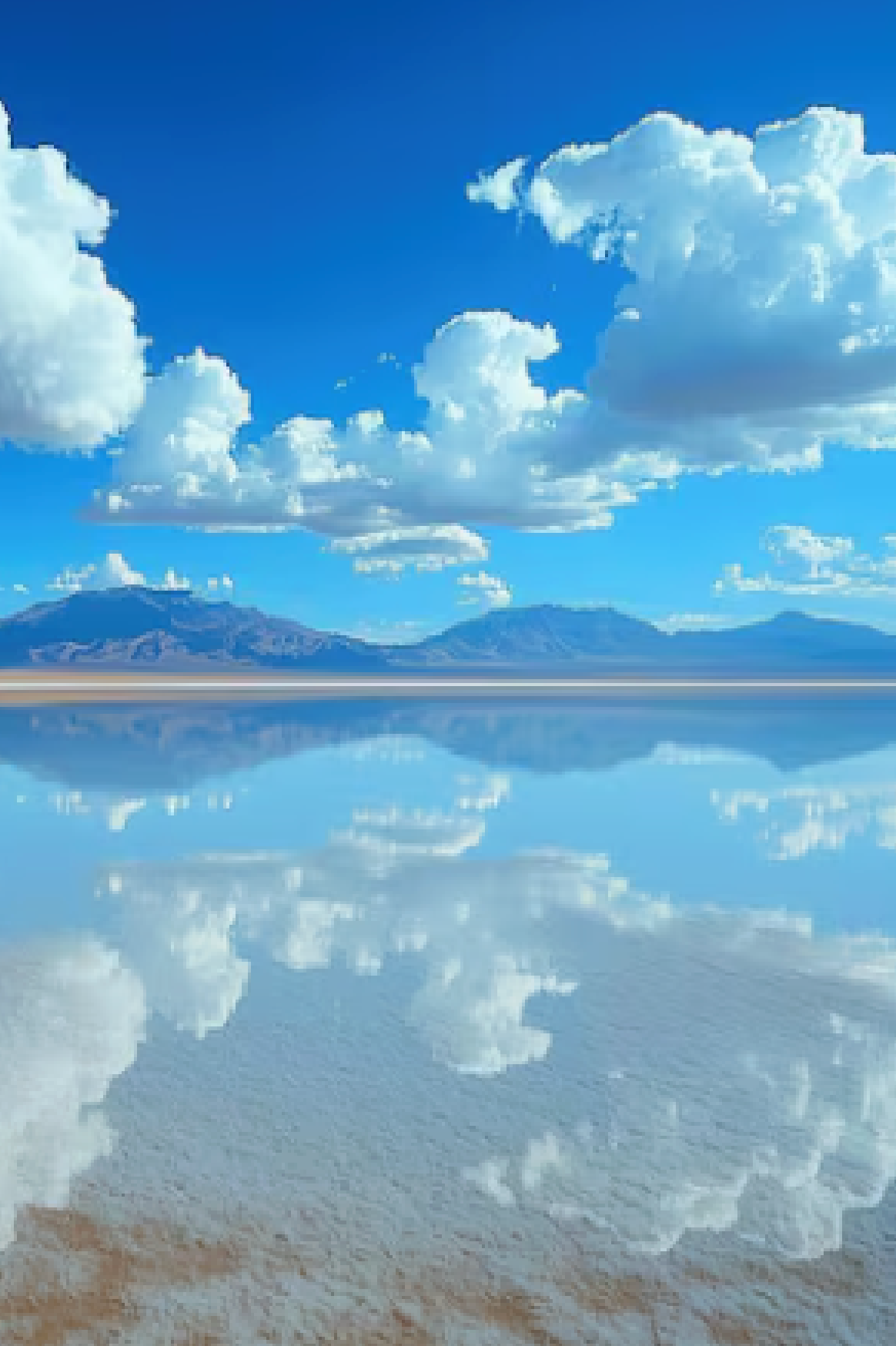
From La Paz, the classic next move is south to Uyuni. Our full guide covers the mirror effect, the best tours, what to pack, and getting there.
| From Copacabana | To | How | Duration | Cost |
|---|---|---|---|---|
| Copacabana | La Paz | Bus (multiple operators) | 3–3.5 hours | USD 3–5 |
| Copacabana | Puno (Peru) | Tourist bus | 3.5–4 hours | USD 7–12 |
| La Paz (onward) | Uyuni | Bus (overnight) or flight | 10 hrs / 1 hr | USD 15–40 / USD 60–120 |
| La Paz (onward) | Sucre | Bus or flight | 13 hrs / 1 hr | USD 18–45 / USD 70–130 |
| Puno (onward) | Cusco | Bus or train | 6–7 hours | USD 10–50 |
Your Flight Connecting Through Lima or Bogota Got Delayed. You May Be Owed Up to 600 EUR.
Most passengers never claim the compensation they are legally entitled to. AirHelp does it for you — no paperwork, no calls, no stress. They only take a fee if they win.
Takes 2 minutes to check. Zero risk.Copacabana Travel Budget: What It Really Costs
Copacabana is one of the more affordable stops on the Andean circuit. Bolivia is consistently the cheapest country in South America for travellers, and Copacabana — despite its tourist traffic — has not been overpriced the way San Pedro de Atacama or Cusco’s tourist centre has.
| Budget Level | Daily Budget (USD) | Breakdown |
|---|---|---|
| Backpacker | $25–40 | Hostel dorm or basic private ($8-15) + meals ($8-12) + activities ($5-10) |
| Mid-range | $50–80 | Mid-range guesthouse ($25-45) + restaurant meals ($15-20) + Isla del Sol day trip |
| Comfort | $100–150 | Lakefront hotel ($70-120) + full board + guided Isla del Sol tour |
Budget note: The one ATM in Copacabana runs dry on weekends and during festival periods. Withdraw BOB 500–1,000 before leaving La Paz or Puno. Card payments are not reliable in most restaurants and guesthouses. USD cash is accepted in some tourist-facing places but at poor rates. Bring enough bolivianos to cover your stay.
Frequently Asked Questions: Copacabana Bolivia 2026
Is the north end of Isla del Sol open in 2026?
As of May 2026, access to the north end of Isla del Sol — including the Sacred Rock and Chincana ruins — remains disputed due to an ongoing conflict between northern and southern island communities. The situation can change quickly. Before buying your boat ticket, ask the operator specifically whether north-end access is currently safe and open. The south end (Yumani) is fully accessible and worth the trip on its own.
Do I need a visa to enter Bolivia from Peru?
Most nationalities do not need a visa to enter Bolivia for tourism. Citizens of the US, EU, UK, Australia, Canada, and most of Latin America enter visa-free for 30–90 days depending on nationality. The border crossing at Kasani (between Puno and Copacabana) is a straightforward land crossing — exit Peru, walk 100 metres, enter Bolivia. No fees apply for most nationalities as of 2026.
Is there Wi-Fi in Copacabana?
Most guesthouses and restaurants offer Wi-Fi but speeds are slow and reliability varies. Do not plan to work remotely from Copacabana. Download offline maps (Maps.me or Google Maps offline) and any content you need before leaving La Paz or Puno. Mobile data is available on Tigo and Entel Bolivia SIMs but coverage outside the town centre is patchy.
Can I do a day trip to Copacabana from La Paz?
Technically yes — a very long and exhausting one. The bus is 3–3.5 hours each way, which leaves you under 4 hours in Copacabana. You would see the cathedral and nothing else. We strongly recommend at least one overnight stay, ideally two, to visit Isla del Sol and experience the sunset. A day trip wastes most of the journey.
What is the best time of year to visit Copacabana?
May through September is the dry season — clear skies, cold nights, and the best visibility for lake and mountain views. June and July are ideal: dry, not too cold, and outside peak tourist season. August 5–6 is the major festival and should be avoided unless you specifically want the pilgrimage experience (book months ahead if so). October–November and March–April are shoulder seasons with some rain but fewer tourists.
Is the Tiquina ferry crossing safe?
Yes — the Tiquina crossing has been operating for generations and is entirely routine. Passengers and buses cross on separate flat-bottomed wooden ferries. The crossing takes about 10 minutes. The water is calm in most conditions. It is part of the experience, not a risk to assess.
Can I pay in US dollars in Copacabana?
Some tourist-facing restaurants and guesthouses accept USD, but at poor exchange rates and only in small denominations ($1, $5, $10 notes). The standard and preferred currency is the Bolivian Boliviano. Withdraw BOB from the ATM in La Paz before arriving — the town’s single ATM regularly runs out of cash on weekends and festival periods.
How do I get from Copacabana to Machu Picchu?
The standard route is: bus from Copacabana to Puno (3.5–4 hours), bus or train from Puno to Cusco (6–7 hours), then train from Aguas Calientes to Machu Picchu. The full journey takes 2–3 days depending on connections. Alternatively, fly from La Paz to Cusco (1 hour) and take the train from there. See our full Machu Picchu guide for 2026 ticketing details.
What should I eat in Copacabana?
Trucha (Lake Titicaca trout) is the essential dish — order it fried (a la plancha) or baked in garlic butter. A full plate costs BOB 35–55 (USD 5–7). Also try sopa de quinoa (quinoa soup), a staple of the altiplano. Avoid eating raw vegetables or anything washed in tap water at cheaper establishments. Most restaurants on Avenida 6 de Agosto cater to tourists and are safe.
Is Copacabana suitable for families with children?
Yes, with some planning. The altitude (3,841m) affects children as much as adults — allow a full acclimatisation day before any physical activities. The town is small, safe, and easy to navigate. Isla del Sol is a wonderful experience for older children (8+) who can manage the steep Inca staircase and ridge trails. Younger children may find the altitude and physical demands difficult.
Conclusion: Why Copacabana Stays With You
There are places you visit and places that change you slightly while you are there. Copacabana is the second kind. Maybe it is the altitude making everything feel more intense. Or Maybe it is standing at 3,841 metres watching a priest sprinkle beer on a truck decorated with plastic flowers while a brass band plays cumbia at 9am. Maybe it is the lake — that impossible blue that stretches further than you expect and reflects the mountains of Peru back at you from the other side.
Whatever it is, the people who spend a single day in Copacabana usually wish they had stayed longer. Give it two nights minimum. Climb the Calvario at sunrise. Take the boat to Isla del Sol. Eat the trout. Watch the sunset from the jetty. These are not tourist boxes to tick — they are genuinely memorable experiences that cost almost nothing and stay with you for years.
If this guide helped you plan your trip, explore the rest of uncovertheandes.com. We cover Peru, Bolivia, Colombia, Ecuador, Argentina, and Chile with the same depth and insider knowledge — because we have lived and travelled these places for decades, not just passed through on a press trip. Every guide is built to be a real tool, not a list of things you already found on the first page of Google. See you in the Andes.
Your Flight to La Paz Starts Here. Compare Fares in Seconds.
La Paz (LPB) is the gateway to Copacabana, Lake Titicaca, and the entire Bolivian altiplano. Search all airlines and booking platforms in one place — and lock in your fare before prices move.
Skyscanner searches 1,200+ airlines. Free to use. No booking fees.