
Most travelers rush through southern Peru on their way to Cusco and Machu Picchu, and in doing so they skip one of the most rewarding corners of the Andes. Arequipa, the elegant “White City” built from pale volcanic stone, sits beneath three snow-capped volcanoes and serves some of the best food in the country. A few hours north, the Colca Canyon drops more than 3,000 meters into the earth, and every morning Andean condors ride the thermals just meters above the heads of visitors at the Cruz del Cóndor viewpoint.
This guide gives you everything you need to plan both in 2026: what to see in Arequipa, how long to stay, how to choose between a one-day tour, a two-day tour or an independent trek in Colca, what the Boleto Turístico costs, how to handle the altitude, and how much the whole trip really costs. Whether you are on a two-week Peru itinerary or a long overland trip through the Andes, Arequipa and Colca deserve at least three or four days.
Why Arequipa and Colca Belong on Your Peru Itinerary
Arequipa is Peru’s second-largest city, but it feels nothing like chaotic Lima. Its historic center is a UNESCO World Heritage Site, built largely from sillar, a white volcanic rock that glows in the afternoon sun. The city sits at about 2,335 meters (7,660 ft), which makes it an ideal intermediate step for acclimatization before you head to Cusco (3,400 m) or Lake Titicaca (3,800 m).
Colca, meanwhile, offers a completely different kind of Andes experience from the Sacred Valley. Terraced fields built before the Incas still climb the canyon walls, traditional Collagua and Cabana communities wear distinctive embroidered clothing, and the trekking down to the green oasis of Sangalle is one of the best short hikes in South America. If you already have Machu Picchu on your list, Colca adds variety without adding much complexity, especially if you travel overland on a route like our Peru and Bolivia 10-day overland itinerary.
Arequipa at a Glance
| Item | Details |
|---|---|
| Altitude | About 2,335 m (7,660 ft) |
| Best time to visit | April to November (dry season); sunny most of the year |
| How long to stay | 2 days in the city + 2 days in Colca |
| Getting there | 1 h 30 min flight from Lima, or 15–17 h bus; 9–11 h bus from Cusco |
| Best area to stay | Historic center (Cercado) or San Lázaro |
| Signature dishes | Rocoto relleno, chupe de camarones, adobo arequipeño, queso helado |
| Main day trip | Colca Canyon (Chivay, Cruz del Cóndor, Cabanaconde) |
Best Things to Do in Arequipa
1. Plaza de Armas and the Cathedral
Arequipa’s main square is one of the most beautiful in South America. Two-story arcades of white sillar frame three sides, and the enormous Basilica Cathedral fills the fourth. On clear days El Misti volcano rises directly behind the cathedral towers. Come early in the morning for photos, and again at sunset when the stone turns golden. Rooftop cafés on the arcades offer the best views; order a coffee and watch the square fill up.
2. Santa Catalina Monastery
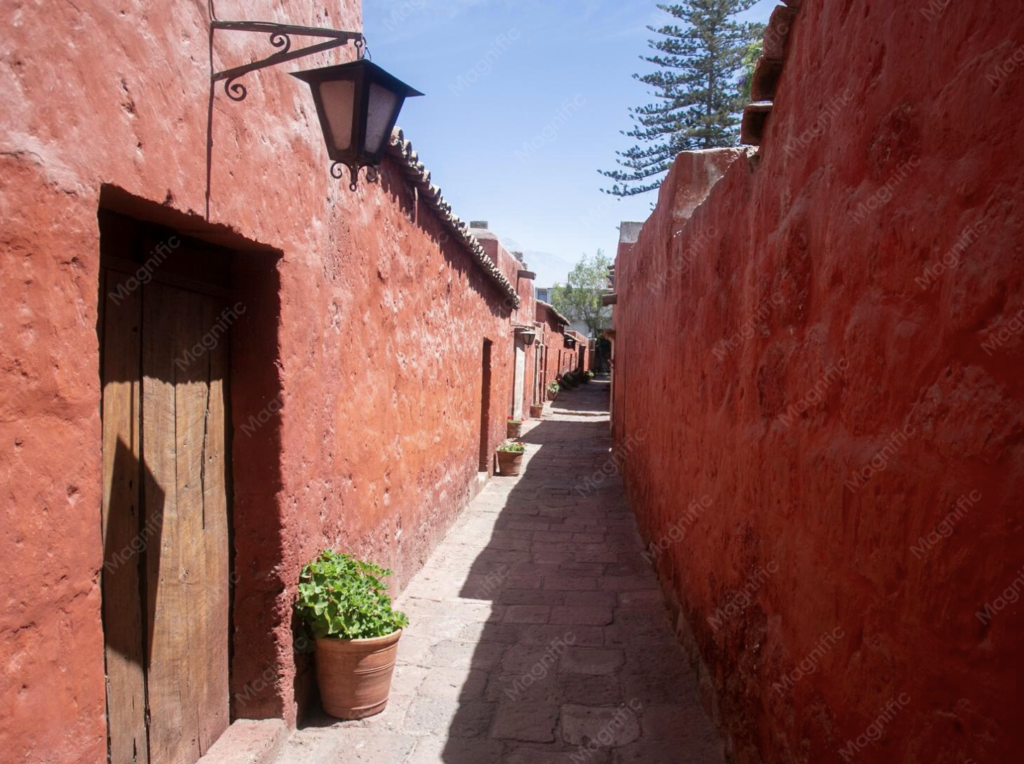
If you only do one paid attraction in Arequipa, make it Santa Catalina. Founded in 1579, this convent is essentially a small walled city within the city, with cobbled streets, cloisters painted in deep blue and terracotta, kitchens, laundries and cells where nuns lived in near-total isolation for centuries. Plan at least two hours. On some evenings the monastery opens late and is lit by candles and lanterns, which is a magical experience.
3. Museo Santuarios Andinos and “Juanita”
This small museum holds Juanita, the remarkably well-preserved body of an Inca girl offered as a sacrifice on the summit of Ampato volcano more than five centuries ago and discovered in 1995. Visits are guided and include a documentary and the objects found with her. It is a moving and fascinating introduction to Inca religious rituals in the high Andes.
4. San Camilo Market
Arequipa’s main market is the best place to understand local food culture. Try fresh fruit juices, browse the dozens of potato and corn varieties, and look for queso helado, a creamy cinnamon-dusted frozen dessert that is unique to the city. It is also a cheap place for lunch.
5. Yanahuara and Carmen Alto viewpoints
A short taxi ride from the center, the Yanahuara viewpoint frames El Misti through white sillar arches. Carmen Alto, a little further, offers sweeping views of the countryside, terraces and all three volcanoes: El Misti (5,822 m), Chachani (6,057 m) and Pichu Pichu.
6. The Sillar Route
Half-day tours visit the quarries where sillar is still cut by hand, and the Culebrillas canyon with its petroglyphs. It is a great way to understand why Arequipa looks the way it does.
7. Eat at a traditional picantería
Arequipa has one of the strongest regional cuisines in Peru. Picanterías are traditional lunch restaurants where you should try rocoto relleno (a spicy pepper stuffed with meat and topped with cheese), chupe de camarones (river shrimp chowder), ocopa, and on Sundays adobo arequipeño, a slow-cooked pork stew eaten for breakfast. Portions are huge; share.
🏨 WHERE TO STAY
Book your stay with free cancellation
Hostels, boutique hotels and Andean lodges with verified guest reviews and flexible bookings in case your plans change.
✓ No booking fees · ★ 28M+ listings · ↺ Free cancellation on most stays
Where to Stay in Arequipa
The historic center is compact and walkable, and staying within five or six blocks of the Plaza de Armas means you can walk to almost everything. San Lázaro, the oldest neighborhood, has quiet cobbled lanes and charming boutique guesthouses. Yanahuara is calmer and more residential but requires a short taxi to the center.
| Budget level | Typical price per night | What you get |
|---|---|---|
| Hostel dorm | US$10–18 | Social atmosphere, rooftop terraces, tour desks |
| Mid-range hotel | US$40–80 | Colonial houses with courtyards, breakfast included |
| Boutique / luxury | US$100–250 | Restored mansions, volcano views, spa services |
Book early for July, August and the Arequipa anniversary week in mid-August, when prices rise and the best places sell out.
Colca Canyon: What You Need to Know
The Colca Canyon is roughly 160 kilometers north of Arequipa. At its deepest point it plunges more than 3,000 meters from the surrounding peaks to the river, and it is often described as about twice as deep as the Grand Canyon. The Colca River has carved a valley lined with pre-Inca agricultural terraces, colonial churches and small villages such as Chivay, Yanque, Maca, Pinchollo and Cabanaconde.
The road from Arequipa climbs through the Salinas y Aguada Blanca National Reserve, where you will see vicuñas, alpacas and llamas, before reaching the Patapampa pass at around 4,900 meters. This is the highest point of the trip and where many visitors first feel the altitude. From there the road drops into Chivay (about 3,600 m), the main town at the head of the valley.
The Boleto Turístico (tourist ticket)
Every visitor entering the Colca valley must buy the Boleto Turístico at a checkpoint before Chivay. In 2026 it costs S/70 for foreign visitors and S/40 for visitors from other Latin American countries (Peruvians pay less). Organized tours almost never include it in the advertised price, so carry cash in soles. Keep the ticket with you, because it is checked again at Cruz del Cóndor and on trekking routes.
Condor viewing at Cruz del Cóndor
The Cruz del Cóndor viewpoint is where the canyon narrows and warm air rising from the valley creates the thermals condors need to fly. The best window is early in the morning, roughly between 8:00 and 10:00 am, when the birds leave their nests on the cliffs and glide past the viewpoint. Sightings are never guaranteed, but they are very likely in the dry season. The rainy months (January to March) offer fewer sightings and more cloud.
With a wingspan of up to three meters, the Andean condor is one of the largest flying birds on Earth. Bring binoculars or a telephoto lens; the birds often pass so close that a phone is enough, but a zoom makes a huge difference when they circle lower in the canyon.
🛒 GEAR PICK ON AMAZON
Compact binoculars for condor watching
A light 8x or 10x waterproof pair makes Cruz del Cóndor far more rewarding — you will see feather detail as condors circle below the viewpoint.
How to Visit Colca: Tour vs Trek Compared
You have three main ways to visit the canyon. The right one depends on your time, fitness and how much you care about seeing the condors versus hiking into the canyon itself.
| Option | Duration | Typical price (2026) | Pros | Cons |
|---|---|---|---|---|
| Full-day tour | Departure ~3:00 am, return ~6:00 pm | US$20–65 | Fits a tight schedule, sees condors | Very long day, rushed, high altitude quickly |
| 2-day / 1-night tour | 2 days | US$35–240 | Hot springs, villages, more relaxed pace | Little or no hiking |
| Guided 2- or 3-day trek | 2–3 days | US$45–400 | Hike to the canyon floor, Sangalle oasis | Steep climb out, requires fitness |
| Independent trek | 2–3 days | US$40–80 + ticket | Freedom, cheap, authentic villages | Need to plan buses and lodging yourself |
Prices vary enormously depending on group size, transport quality, and whether the hotel in Chivay is a basic lodge or a comfortable resort with private hot springs. Remember that the Boleto Turístico, meals and hot springs entrance are usually extra.
The full-day tour
One-day tours pick you up from your hotel at around 3:00 am, stop for breakfast in Chivay, reach Cruz del Cóndor in the morning, and return via several viewpoints and villages, arriving back in Arequipa in the early evening. It is efficient, but it is a punishing day with roughly 12 hours in a minibus and a fast climb to nearly 5,000 meters. Choose it only if you are short on time.
The two-day tour
The classic two-day tour leaves Arequipa in the morning, crosses Patapampa, and arrives in Chivay for lunch. The afternoon is spent at the La Calera hot springs (entrance around S/15–20) and exploring the village. The next morning you visit Cruz del Cóndor at the best hour, stopping at Yanque, Maca and several terraced viewpoints on the way. This is the best option for most visitors who do not want to hike.
Trekking into the canyon
For hikers, Colca is at its best on foot. The classic route starts in Cabanaconde, descends steeply around 1,100 meters to the river, crosses to the small villages of San Juan de Chuccho and Cosñirhua, and ends in the Sangalle oasis, where lodges have swimming pools fed by spring water. On the final day you climb back out to Cabanaconde, usually starting before dawn to avoid the sun. The climb takes three to four hours and is tough, but very doable for anyone with average fitness. Mules are available if your knees give up.
If you enjoy this kind of hiking, compare it with other high-Andean treks such as the Salkantay Trek or the routes around Huaraz and the Cordillera Blanca.
🎟 TOURS & ACTIVITIES
Book guided tours with local experts
Day trips, treks and experiences led by licensed guides, with free cancellation up to 24 hours before.
✓ Licensed guides · ★ 10M+ happy travelers · ↺ Free cancellation
Sample 3-Day Colca Trek Itinerary
| Day | Route | Distance / Time | Highlights |
|---|---|---|---|
| Day 1 | Arequipa → Cruz del Cóndor → Cabanaconde → San Juan de Chuccho | Bus 5–6 h + 3 h descent | Condors, first views into the canyon |
| Day 2 | San Juan de Chuccho → Cosñirhua → Malata → Sangalle oasis | 4–5 h | Villages, fruit orchards, swimming pools |
| Day 3 | Sangalle → Cabanaconde → Chivay → Arequipa | 3–4 h climb + 6 h transport | Sunrise ascent, La Calera hot springs |
If you only have two days, skip San Juan de Chuccho and hike directly from Cabanaconde to Sangalle on day one, climbing out early on day two.
Altitude: How to Stay Healthy in Arequipa and Colca
Arequipa itself sits at a moderate altitude, but Colca takes you much higher very quickly. The Patapampa pass is near 4,900 meters, Chivay is above 3,600 meters, and even the canyon floor is higher than most ski resorts in Europe. Many people feel headaches, shortness of breath or poor sleep on their first night in Chivay.
- Spend at least two nights in Arequipa before going to Colca.
- Drink plenty of water and avoid heavy alcohol on the first night.
- Try coca tea or coca candies, which are offered on most tours.
- Walk slowly at altitude, especially on stairs and climbs.
- Talk to a doctor before your trip about altitude medication if you are prone to altitude sickness.
Our detailed guide to altitude sickness in Cusco and Machu Picchu covers symptoms, prevention and when to descend, and all of it applies in Colca as well.
🛡 TRAVEL INSURANCE
Trek the Andes fully covered
Medical cover built for long trips and nomads, from about $1.60 per day. Sign up even if you are already on the road.
✓ 180+ countries · ⚕ Hospital & emergency cover · ⏱ Cancel anytime
How to Get to Arequipa
By air
Arequipa’s Rodríguez Ballón airport has frequent flights from Lima (about 1 h 30 min) and direct connections with Cusco and Juliaca on some days. Booking a few weeks ahead usually gets you the best fares, and a multi-city ticket (fly into Lima, out of Cusco) often works better than a return flight.
By bus
Peru has an excellent long-distance bus network with reclining “cama” seats. Typical routes: Lima to Arequipa (15–17 h), Cusco to Arequipa (9–11 h), Puno to Arequipa (5–6 h), and Ica/Huacachina to Arequipa (around 12 h). Choose reputable companies and travel in the premium classes on overnight routes.
| Route | Bus time | Bus cost | Flight time |
|---|---|---|---|
| Lima → Arequipa | 15–17 h | US$30–60 | 1 h 30 min |
| Cusco → Arequipa | 9–11 h | US$20–45 | ~1 h (limited) |
| Puno → Arequipa | 5–6 h | US$10–25 | No direct flights |
| Arequipa → Chivay | 3–4 h | US$5–8 | — |
| Arequipa → Cabanaconde | 5–6 h | US$7–10 | — |
✈ FIND CHEAP FLIGHTS
Fly to South America for less
Compare hundreds of airlines and booking sites at once and grab the lowest fare for your dates — including budget domestic hops between Andean cities.
✓ Free to use · 🌍 100M+ travelers monthly · 🔔 Price alerts
Arequipa and Colca Budget: What It Really Costs
Southern Peru is good value. Here is a realistic budget for four days (two in Arequipa, two in Colca) per person, excluding international flights.
| Expense | Budget traveler | Mid-range traveler |
|---|---|---|
| Accommodation (4 nights) | US$50 | US$220 |
| Food and drinks | US$50 | US$120 |
| Colca tour or trek | US$45 | US$150 |
| Boleto Turístico | US$19 (S/70) | US$19 (S/70) |
| Santa Catalina + museums | US$20 | US$25 |
| Local transport | US$10 | US$30 |
| Total | ~US$195 | ~US$565 |
For a full country breakdown, see our guide to how much it costs to travel the Peruvian Andes.
Best Time to Visit Arequipa and Colca
Arequipa is famous for its sunshine; it gets clear skies on most days of the year. The dry season, from April to November, is the best time for Colca: skies are clear, trails are dry, and condor sightings are most reliable. June to August brings cold nights, especially in Chivay and Cabanaconde, where temperatures fall below freezing. December to March is the rainy season in the highlands; roads can be affected and clouds may hide the canyon, though the landscape turns spectacularly green. Read more in our guide to the best time to visit Peru.
What to Pack for Colca
- Layers: mornings are freezing, middays are hot in the canyon.
- Sturdy hiking shoes or boots with good grip for the steep, loose descent.
- Sun hat, high-SPF sunscreen and sunglasses: the UV at altitude is intense.
- Swimsuit for La Calera hot springs and the Sangalle pools.
- Headlamp for pre-dawn starts.
- Reusable water bottle with a filter.
- Cash in small soles notes: ATMs are scarce outside Chivay.
Our gear guides on the best base layers for high-altitude trekking and best high-altitude trekking boots will help you choose the right kit, and the article on why choosing the right boots matters explains what to look for on steep descents like Colca’s.
🛒 GEAR PICK ON AMAZON
Collapsible trekking poles
The 1,100-meter descent into Colca is brutal on knees. A pair of light, foldable poles makes both the descent and the pre-dawn climb out much easier.
Combining Arequipa and Colca with the Rest of Peru
Arequipa fits naturally into a southern Peru loop. A classic route is Lima → Paracas/Huacachina → Arequipa and Colca → Puno and Lake Titicaca → Cusco and Machu Picchu. This order also helps acclimatization, because you climb gradually from sea level to 2,335 m, then 3,600 m, then 3,800 m before Cusco. After Arequipa, continue to Copacabana on the Bolivian side of Lake Titicaca or to Cusco; our 5-day Cusco, Sacred Valley and Machu Picchu itinerary picks up neatly from there. For an overview of the country, start with our Peru travel guide.
Planning to explore the whole region? Our guide to sustainable trekking in the Andes shows how to hike responsibly in fragile places like Colca, where local communities depend on tourism but also on their terraces and water sources.
Safety in Arequipa and Colca
Arequipa is considered one of the safer large cities in Peru, and Colca is very safe. The usual precautions apply: use registered taxis or ride-hailing apps at night, keep valuables out of sight in markets and bus stations, and avoid walking alone in empty streets late at night. In Colca, the main risks are the sun, the altitude and steep trails. Read our honest guide to safety in Peru for country-wide advice.
Frequently Asked Questions
How many days do I need for Arequipa and Colca Canyon?
Plan at least four days: two days in Arequipa to see the city and acclimatize, and two days in Colca for a two-day tour or a short trek. A three-day trek plus two city days (five days total) is ideal.
How much is the Colca Canyon tourist ticket in 2026?
The Boleto Turístico costs S/70 for foreign visitors and S/40 for visitors from other Latin American countries. It is rarely included in tour prices, so bring cash in soles.
Is the one-day Colca tour worth it?
It is worth it only if you have no extra time. The day starts around 3:00 am and involves about 12 hours of driving, but you will see the condors and the main viewpoints. A two-day tour is far more relaxed.
When is the best time to see condors in Colca?
Go to Cruz del Cóndor early in the morning, roughly 8:00 to 10:00 am, during the dry season from April to November. Sightings are less frequent in the rainy months.
How hard is the Colca Canyon trek?
The trails are steep but well marked. The descent is hard on the knees and the climb out of the canyon takes three to four hours with about 1,100 meters of elevation gain. Anyone with average fitness can do it slowly; mules are available.
Can I hike Colca Canyon without a guide?
Yes. Take a public bus from Arequipa to Cabanaconde, buy the Boleto Turístico, and follow the marked trails to San Juan de Chuccho and Sangalle. Lodging is simple and can be found on arrival outside peak season.
Will I get altitude sickness in Colca?
Many visitors feel mild symptoms because the road crosses a pass near 4,900 meters and Chivay is above 3,600 meters. Spending two nights in Arequipa first, drinking water and avoiding alcohol helps a lot.
Is Arequipa safe for tourists?
Arequipa is one of the safer cities in Peru. Use app taxis at night, keep your phone out of sight on the street, and take normal precautions at bus terminals and markets.
What food should I try in Arequipa?
Try rocoto relleno, chupe de camarones, ocopa, adobo arequipeño on Sundays, and queso helado for dessert. Traditional picanterías are the best places to eat them.
Is Colca Canyon deeper than the Grand Canyon?
Yes. At its deepest point Colca drops more than 3,000 meters, roughly twice the depth of the Grand Canyon. The nearby Cotahuasi Canyon is even deeper.
Conclusion: Don’t Skip Southern Peru
Arequipa and the Colca Canyon offer a rare combination: a relaxed, beautiful city with outstanding food, and one of the deepest canyons on Earth, complete with condors, hot springs and some of the best short treks in the Andes. They also make your whole Peru trip easier by helping you acclimatize before Cusco and Lake Titicaca. Give them four or five days, book your Colca tour or plan your trek, and you will leave with some of the most memorable moments of your journey.
Ready to plan the next step? Continue with our Cusco travel guide or our Machu Picchu travel guide, and check the new Machu Picchu entry rules for 2026 before you book.