
At roughly 3,810 meters above sea level, Lake Titicaca is often called the highest navigable lake in the world. It is huge, deep blue and surrounded by snowy peaks, and according to Andean mythology it is the birthplace of the Inca civilization. On the Peruvian side, the town of Puno is the gateway to three very different island experiences: the floating reed islands of the Uros, the weaving island of Taquile, and the farming island of Amantaní, where you can sleep in a local family’s home.
This guide explains how to plan your visit in 2026: which islands to visit, how a one-day tour compares with an overnight homestay, what everything costs, how to get to Puno, how to cope with the altitude, and how to combine Titicaca with Cusco, Arequipa or Bolivia. If you are building a longer route, Titicaca fits perfectly between southern Peru and Bolivia on our Peru and Bolivia overland itinerary.
Lake Titicaca at a Glance
| Item | Details |
|---|---|
| Altitude | Lake surface about 3,810 m; Puno about 3,830 m |
| Countries | Shared between Peru (west) and Bolivia (east) |
| Gateway town (Peru) | Puno |
| Gateway town (Bolivia) | Copacabana |
| Main islands (Peru) | Uros, Taquile, Amantaní |
| Nearest airport | Juliaca (about 45–60 min from Puno) |
| Best time to visit | April to November (dry, sunny, cold nights) |
| Recommended time | 2–3 days including at least 1 night on Amantaní or Taquile |
Puno: The Gateway to Lake Titicaca
Puno is not a pretty colonial city like Cusco or Arequipa, but it has a lively character, a pleasant pedestrian street (Jirón Lima), a cathedral on the Plaza de Armas and great views of the lake from the Kuntur Wasi viewpoint. It is also known as the folklore capital of Peru. Every February the city hosts the Fiesta de la Candelaria, one of the largest festivals in South America, with tens of thousands of dancers in elaborate costumes and masks. If you visit in early February, book accommodation months in advance.
Most travelers spend one or two nights in Puno, using it as a base for tours to the islands and to Sillustani, the burial towers on Lake Umayo. Stay near the Plaza de Armas or along the lakeshore; some upscale hotels sit right on the water with private docks.
🏨 WHERE TO STAY
Book your stay with free cancellation
Hostels, boutique hotels and Andean lodges with verified guest reviews and flexible bookings in case your plans change.
✓ No booking fees · ★ 28M+ listings · ↺ Free cancellation on most stays
The Uros Floating Islands
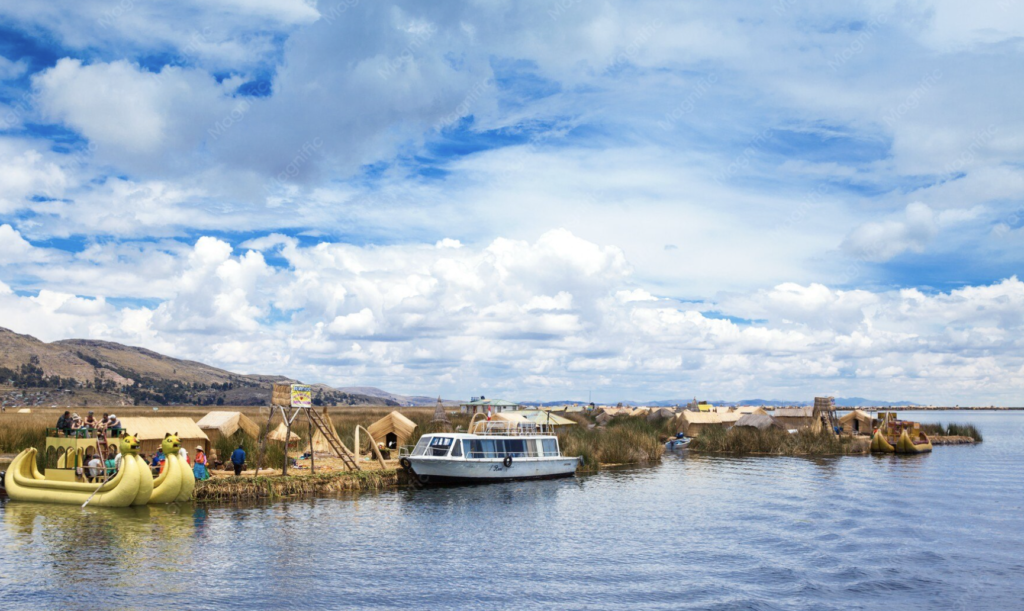
Just a 20 to 30-minute boat ride from Puno’s port, the Uros islands are one of the most unusual sights in the Andes. They are built entirely from totora, a reed that grows in the shallow bays of the lake. Families stack layers of reeds over blocks of buoyant roots, then add fresh layers every few weeks as the bottom ones rot away. Houses, watchtowers and the famous dragon-headed reed boats are made from the same plant, which is also eaten.
The Uros people originally took to the water centuries ago to keep their independence from other groups, including the Incas. Today around a hundred islands remain in the bay of Puno, each home to a few families. Visits are short and structured: the island president explains how the islands are built, you visit a home, and you are invited to buy handicrafts and take a ride on a reed boat for a small extra fee.
Some travelers find the Uros visit touristic, and it is. But tourism is now the main source of income for these families, and the explanations are fascinating. Go with realistic expectations, buy something directly from the women who made it, and you will have a positive experience. A small community entrance fee is collected on arrival and is usually not included in tour prices.
Taquile Island: Living Textile Tradition
Taquile lies about 35 kilometers from Puno, roughly two and a half to three hours by slow boat. It is a long, narrow island of stone-walled terraces, Inca-era paths and sweeping views across the lake to the Bolivian Cordillera Real. Its people are Quechua speakers who manage tourism collectively.
Taquile is famous for its textiles. The weaving tradition of the island has been recognized by UNESCO as a masterpiece of intangible cultural heritage. On Taquile it is the men who knit, often while walking, and their hats (chullos) communicate marital status: red-and-white hats for single men, mostly red for married men. Women weave the colorful belts and wear dark shawls with pompoms that also carry meaning. The community cooperative store on the main square sells high-quality textiles at fixed prices.
A typical visit involves a walk from the dock up to the main plaza, a lunch of fresh trout or quinoa soup in a family restaurant, and a walk down a long stone stairway to the boat on the other side of the island. The climb is short but steep, and at 3,950 meters you will feel it.
Amantaní Island: The Homestay Experience
Amantaní is larger, higher and more traditional than Taquile, and it is the island where most overnight tours stop. There are no cars and no hotels in the conventional sense; visitors are hosted by local families, who rotate guests so that tourism income is shared across the community.
A homestay on Amantaní is simple: a clean room with thick blankets, home-cooked meals of soup, potatoes, quinoa and local cheese, and usually no running hot water. In the afternoon, guests hike up to one of the two hilltop ceremonial sites, Pachatata (Father Earth) and Pachamama (Mother Earth), at over 4,100 meters, to watch the sunset over the lake. In the evening families often dress their guests in traditional clothing for a community dance in the village hall.
It is not luxury, and the cold at night is intense, but for many travelers the Amantaní homestay is the most memorable part of their entire trip to Peru.
🎟 TOURS & ACTIVITIES
Book guided tours with local experts
Day trips, treks and experiences led by licensed guides, with free cancellation up to 24 hours before.
✓ Licensed guides · ★ 10M+ happy travelers · ↺ Free cancellation
Tour Options and Prices in 2026
You can visit the islands on a half-day trip, a full-day tour or a two-day tour with a homestay. Prices below are typical ranges for shared tours booked in Puno or online. Community entrance fees for Uros and Taquile and the lunch are not always included, so check before you pay.
| Tour | Duration | Typical price per person | Includes | Best for |
|---|---|---|---|---|
| Uros half-day | 3 hours | US$10–20 | Boat, guide | Short visits, arrival day |
| Uros + Taquile full day | 8–9 hours | US$25–45 | Boat, guide, sometimes lunch | Travelers with one day |
| Uros + Amantaní + Taquile (2 days) | 2 days / 1 night | US$45–90 | Boat, guide, homestay, 3 meals | Most travelers |
| Fast-boat Uros + Taquile | 6–7 hours | US$45–70 | Speedboat, guide, lunch | Saving time |
| Private or luxury lake tours | 1–3 days | US$150+ | Private boat, lodges, kayaking | Comfort and flexibility |
Our recommendation for most people is the two-day tour: Uros on the morning of day one, Amantaní homestay overnight, and Taquile on day two before returning to Puno in the afternoon.
Kayaking and alternative experiences
Some operators offer kayak tours from Llachón on the Capachica peninsula, where you can also stay with families in a more relaxed setting than Amantaní. Another option is Isla Suasi, a private island with an eco-lodge, ideal for a quiet, upscale break. For a less-visited Uros experience, ask about community-run tours to the more distant islands.
Sillustani: The Burial Towers Near Puno
About 35 kilometers from Puno, on a peninsula in Lake Umayo, stand the chullpas of Sillustani: tall, cylindrical stone burial towers built by the Colla people before the Incas, and later by the Incas themselves. The setting is dramatic, especially in the late afternoon light. Half-day tours (US$15–25) leave in the afternoon, and Sillustani is also an easy stop if you travel from Juliaca airport to Puno.
How to Get to Puno
| From | Transport | Time | Typical cost |
|---|---|---|---|
| Cusco | Day bus or tourist bus with stops | 6–7 h (regular) / 10 h (tourist) | US$15–30 / US$50–70 |
| Cusco | Luxury train (Titicaca route) | ~10 h | US$300+ |
| Arequipa | Bus | 5–6 h | US$10–25 |
| Lima | Flight to Juliaca + transfer | 1 h 40 min + 1 h | US$60–180 |
| La Paz (Bolivia) | Bus via Copacabana | 8–10 h | US$15–30 |
The tourist bus between Cusco and Puno is a popular choice because it turns the transfer into a sightseeing day, stopping at Andahuaylillas church, Raqchi, La Raya pass and Pucará. The regular bus is cheaper and faster.
✈ FIND CHEAP FLIGHTS
Fly to South America for less
Compare hundreds of airlines and booking sites at once and grab the lowest fare for your dates — including budget domestic hops between Andean cities.
✓ Free to use · 🌍 100M+ travelers monthly · 🔔 Price alerts
Altitude at Lake Titicaca
Puno is higher than Cusco, and the islands are higher still. If you arrive directly from Lima by flying into Juliaca, you will go from sea level to almost 3,900 meters in a few hours, which is a recipe for headaches and sleepless nights. The ideal order is to arrive from Arequipa or Cusco, having already acclimatized for a few days.
- Take it easy on your first day in Puno; do only the Uros half-day trip.
- Drink lots of water and try coca or muña tea.
- Avoid alcohol and heavy meals on the first night.
- Walk slowly up the steps on Taquile and Amantaní.
- Consult a doctor about prevention if you have had altitude problems before.
Read our full guide to altitude sickness in Peru for symptoms and prevention strategies.
🛡 TRAVEL INSURANCE
Trek the Andes fully covered
Medical cover built for long trips and nomads, from about $1.60 per day. Sign up even if you are already on the road.
✓ 180+ countries · ⚕ Hospital & emergency cover · ⏱ Cancel anytime
What to Pack for the Islands
- Warm layers: nights on Amantaní drop below freezing in the dry season.
- A warm hat and gloves.
- Strong sunscreen, sunglasses and a sun hat; the sun on the water is fierce.
- Comfortable walking shoes for the stone steps.
- Headlamp: electricity is limited on the islands.
- Small bills in soles for entrance fees, crafts and tips.
- A small gift for your host family, such as fruit, rice or school supplies.
- Toilet paper and hand sanitizer.
See our best insulation jackets for the Andes guide for warm layers that pack small.
🛒 GEAR PICK ON AMAZON
Rechargeable headlamp
Homestays on Amantaní have limited electricity. A light USB headlamp is essential for the evening dance and night-time trips to the bathroom.
Best Time to Visit Lake Titicaca
The dry season, from April to November, brings blue skies and calm water, which are perfect for boat trips and photos. June to August are the coldest months, with freezing nights but sunny days. The rainy season, December to March, brings afternoon storms and clouds, but also greener landscapes and fewer visitors. February is the month of the Candelaria festival, which is spectacular but crowded. For more, see our guide to the best time to visit Peru.
Peru Side vs Bolivia Side: Which Is Better?
| Factor | Puno (Peru) | Copacabana (Bolivia) |
|---|---|---|
| Main attraction | Uros, Taquile, Amantaní homestays | Isla del Sol, Isla de la Luna |
| Town atmosphere | Busy, practical city | Small, relaxed beach-style town |
| Inca sites | Limited | Strong (Isla del Sol ruins) |
| Cultural experience | Excellent (homestays, textiles) | Good |
| Costs | Low | Very low |
| Access | Juliaca airport, buses from Cusco and Arequipa | Buses from Puno and La Paz |
The best answer is to see both: spend two days on the Peruvian side, then cross the border to Copacabana and continue to La Paz. Read our Copacabana travel guide and La Paz travel guide, and check the Bolivia visa requirements before crossing, as some nationalities need a visa.
Responsible Travel on Lake Titicaca
Tourism has brought much-needed income to island communities, but it has also brought plastic waste and cultural pressure. Choose operators that share income fairly with families, avoid giving sweets or money to children, ask before photographing people, and carry your trash back to Puno. Buying textiles directly from the community cooperatives on Taquile and Amantaní is one of the best ways to support local families. Our guide to sustainable travel in the Andes has more ideas.
Safety in Puno
Puno is generally safe for travelers. As in any Peruvian city, keep valuables secure at the bus terminal and in markets, use registered taxis at night, and be careful of the cold and the sun on the lake. Boat safety standards vary; choose reputable operators with life jackets on board. For more, read our Peru safety guide and, if crossing the border, our Bolivia safety guide.
Sample 3-Day Lake Titicaca Itinerary
| Day | Plan |
|---|---|
| Day 1 | Arrive in Puno from Cusco or Arequipa. Afternoon tour to Sillustani. Dinner on Jirón Lima. |
| Day 2 | Morning boat to the Uros islands, continue to Amantaní. Lunch with your host family, sunset hike to Pachatata, evening dance. |
| Day 3 | Boat to Taquile, walk across the island, lunch, return to Puno. Evening bus to Copacabana or Cusco. |
What to Eat in Puno and on the Islands
Food around Lake Titicaca is simple, hearty and built for the cold. The star ingredient is trout (trucha), farmed in the lake and served fried, grilled, or as ceviche in Puno’s restaurants. On the islands, meals are based on what families grow: potatoes in dozens of varieties, oca, broad beans, quinoa and barley. Quinoa soup is served almost everywhere and is exactly what you want after a cold boat ride.
- Trucha frita: pan-fried lake trout with rice, potatoes and salad.
- Sopa de quinua: thick, warming quinoa soup with vegetables.
- Chairo: a rich highland soup with chuño (freeze-dried potatoes) and meat.
- Pesque de quinua: creamy quinoa with milk and cheese.
- Queso de Amantaní: fresh local cheese, often served with boiled potatoes.
- Muña tea: an Andean mint infusion said to help digestion and altitude.
Vegetarians are well served on the islands, since homestay meals are mostly plant-based. If you have allergies, let your tour operator know in advance so your host family can be told.
Photography Tips for Lake Titicaca
The light on Titicaca is intense and crisp, which makes for spectacular photos but also harsh contrast at midday. The best moments are sunrise over the lake from Puno’s lakeshore, the late afternoon on Taquile’s stone arches, and sunset from Pachatata on Amantaní, when the Bolivian Cordillera Real turns pink across the water.
- Always ask before photographing people, especially children and elders. Some may ask for a small tip.
- Use a polarizing filter to cut glare and deepen the blue of the water.
- Bring extra batteries: cold drains them quickly, and charging is limited on the islands.
- Drones are restricted in some areas and frowned upon in communities; ask first.
Common Mistakes to Avoid
- Flying straight from Lima to Juliaca. The altitude jump is huge. Arrive from Arequipa or Cusco if you can.
- Only visiting the Uros. The real highlights are Taquile and Amantaní.
- Underestimating the cold. Nights in the dry season drop below freezing, and homestays are not heated.
- Booking the cheapest tour without checking inclusions. Very low prices often exclude entrance fees and lunch, or cut out Taquile.
- Not carrying cash. There are no ATMs on the islands.
Frequently Asked Questions
How many days do I need in Puno and Lake Titicaca?
Two to three days is ideal: one day to arrive and visit Sillustani or the Uros, and a two-day island tour with an overnight homestay on Amantaní or Taquile.
Are the Uros floating islands worth visiting?
Yes, as long as you expect a short, tourist-oriented visit. The islands are a fascinating example of how people adapted to the lake, and tourism is now a key income source for the families who live there.
How much does a Lake Titicaca tour cost from Puno?
In 2026 a half-day Uros tour costs about US$10–20, a full-day Uros and Taquile tour about US$25–45, and a two-day tour with an Amantaní homestay about US$45–90. Community entrance fees are often extra.
Is the Amantaní homestay comfortable?
It is simple but clean. Expect a basic private room, warm blankets, home-cooked meals and limited electricity and hot water. It gets very cold at night, so bring warm clothes.
Is Puno higher than Cusco?
Yes. Puno sits at about 3,830 meters, roughly 400 meters higher than Cusco. Arriving from Cusco or Arequipa helps your body acclimatize.
How do I get from Cusco to Puno?
Take a regular day bus (6–7 hours), a tourist bus with sightseeing stops (about 10 hours), or the luxury train. You can also fly from Lima or Cusco to Juliaca and transfer to Puno.
Which side of Lake Titicaca is better, Peru or Bolivia?
Peru offers the Uros floating islands and authentic homestays on Amantaní and Taquile; Bolivia offers relaxed Copacabana and the Inca ruins of Isla del Sol. If you have time, visit both.
Can I visit the islands without a tour?
Yes. Community boats leave from Puno’s port to Uros, Taquile and Amantaní, and you can arrange homestays on arrival. It is cheaper but requires more Spanish and flexibility.
What should I bring to Amantaní?
Warm layers, a hat and gloves, a headlamp, sunscreen, small bills in soles, and a small gift for your host family such as fruit, rice or school supplies.
When is the Fiesta de la Candelaria in Puno?
The Candelaria festival takes place in the first half of February each year, with the main dance competitions over several days. Book accommodation well in advance.
Conclusion: Spend the Night on the Lake
Lake Titicaca rewards travelers who slow down. A quick boat ride to the Uros is interesting, but the real magic happens when you stay overnight on Amantaní, watch the sunset from an ancient hilltop temple, eat dinner with a local family and wake up to a lake as blue as the sky. Combine Puno with Arequipa, Cusco or Bolivia, plan your altitude carefully, and Titicaca will be one of the highlights of your journey through the Andes.
Next, read our guide to the most beautiful places in the Andes or start planning Cusco with our Cusco travel guide.